Online education trends
The future of online courses: what AI changes about education, course sales and student expectations
There is a fairly obvious prediction about the future of online education right now.
AI will kill them.
Why pay hundreds or thousands of dollars for an online course when ChatGPT, Claude or another AI tutor can explain the same subject, answer your questions and adapt its explanations to you in seconds?
I think that prediction gets the most important part wrong.
I think AI won't kill online education. But it will expose how much online education was never really education in the first place.
For the last two decades, a significant part of the online course business model has been built around access to information.
An expert knows something you don't. They organize that knowledge into modules, record a collection of videos, add some worksheets, put it behind a login and charge you for access.
That model made perfect sense when high-quality, structured expertise was scarce.
AI changes the economics of that scarcity.
If I want to understand the basics of copywriting, nutrition, leadership, Excel, digital marketing, project management or hundreds of other subjects, I no longer necessarily need to buy a course to access an explanation.
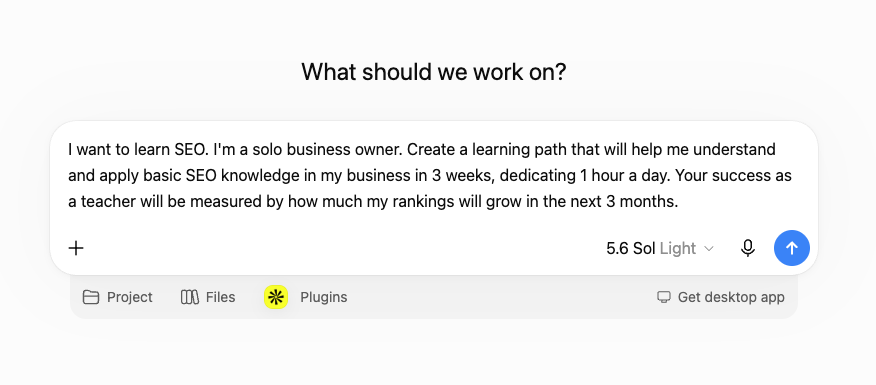
I can ask AI.
If I don't understand the answer, I can ask it to explain it differently.
I can ask a follow-up question.
I can give it an example from my own situation.
I can ask it to test me.
I can ask it to create exercises.
Increasingly, I can interact with something that behaves less like a library of information and more like a private tutor.
That's why I believe the biggest change coming from AI and online education isn't simply that educators will start putting AI inside their programs.
It's that AI changes what education has to be worth paying for.
And that creates an interesting contradiction.
The market for continuing education isn't disappearing. The research points in the opposite direction. Professional continuing education, professional development, digital health coaching and other adjacent markets are all forecast to grow substantially over the coming years.
AI itself is creating an enormous reskilling requirement.
The World Economic Forum's Future of Jobs Report 2025 estimated that 39% of workers' existing skill sets will be transformed or become outdated between 2025 and 2030.
So we may be entering a period in which people need education more often, while simultaneously having less reason to pay simply to receive information.
That tension is at the heart of the future of online education.
The question for an education business is no longer simply:
What should we teach?
It is:
What happens to the person because they came through our program that wouldn't have happened if they'd simply asked AI to teach them the subject?
Because the future value of education increasingly lies beyond access to knowledge.
It lies in transformation, application, accountability, judgment, experience, community and real-world outcomes.
And that has consequences for everything from online course sales and course enrollment to pricing, credentials, learning formats, completion and the fundamental economics of an education business.
Key takeaways in this article
- AI is unlikely to reduce the need for education. It may increase it. Workers will need to reskill more frequently, but AI simultaneously makes information, explanation and basic instruction cheaper and easier to access.
- Information-only courses face the greatest pressure. When AI can explain a subject interactively and personally, access to knowledge becomes a weaker reason to pay premium prices.
- Transformation becomes more valuable than learning alone. Students will increasingly judge programs by whether they help them apply knowledge, develop real capability and achieve the outcome they enrolled for.
- Application will move further inside the curriculum. Strong programs will increasingly combine learning with practice, feedback, real-world projects, supervised experience and evidence of progress rather than leaving application until after graduation.
- AI could create two education booms at once. One around AI skills and technological adaptation, and another around vocational, embodied and deeply human work that relies on physical skill, trust, judgment, care or interpersonal expertise.
- Career-transition programs may need to solve more than qualification. Students aren't only asking, “Can you teach me this?” They're increasingly asking, “Can I actually build a career or livelihood with this afterwards?”
- Graduate outcomes could become an acquisition advantage. Completion, competence, employment, clients, career progression and other student outcomes may increasingly influence reputation, referrals, trust and future enrollment.
- The online course business model may evolve into a transformation ecosystem. Content remains important, but increasingly sits alongside AI support, human expertise, practice, community, assessment, accountability and career or business implementation.
1. The information-only course gets crushed
Let's start with the uncomfortable one.
I think the traditional information-heavy, self-paced online course is facing a serious value problem.
Not all self-paced education. Not all prerecorded content.
But specifically the proposition:
I know information you don't know, so pay me and I'll give you access to it.
That proposition is becoming weaker by the month.
AI has changed the value of an explanation
Consider the traditional online course experience.
You buy a course. You watch Module 1.
Something doesn't quite make sense.
Perhaps the instructor answers your exact question in Module 7. Perhaps there's a community where you can post it. Perhaps you wait until the next office-hours call.
Or perhaps you Google it, get frustrated and abandon the course somewhere around Module 3.
Now compare that with AI in online learning.
A learner can ask for an explanation and immediately say:
I don't understand. Explain that like I'm a beginner.
Then:
Give me an example for my particular business.
Then:
Test whether I've understood it.
Then:
No, I still don't get this part.
Then:
Show me where I'm going wrong.
That doesn't mean AI always gives the right answer. It doesn't mean it replaces genuine expertise. And it certainly doesn't mean every subject can safely or effectively be learned from a chatbot.
But it changes the learner's reference point.
Static information now has to compete with interactive information.
That matters enormously for AI and online courses.
If the primary value of a $997 course is 30 hours of an expert explaining information that an AI system can explain interactively, the obvious question becomes:
Why is this worth $997?
That's not a marketing problem.
It's a product-value problem.
The course doesn't disappear. Its job changes.
This doesn't mean prerecorded lessons vanish from the future of online learning.
They're efficient. They're convenient. Learners can consume them when it suits them, and asynchronous online learning remains a major part of the education market. Your industry research also identifies synchronous, hybrid, mobile and AI-supported formats as increasingly important alongside it.
The distinction I'm making is different.
Content becomes infrastructure.
The video explaining the framework may still matter.
But perhaps it's no longer the thing that justifies the price.
The scarce value moves elsewhere:
- Which information actually matters?
- How should I apply it to my situation?
- Am I doing this correctly?
- What am I missing? Can somebody observe me doing it? Can I practice safely? Can I get expert feedback? Can I learn alongside people attempting the same thing? Will somebody notice when I'm stuck? Can this qualification credibly demonstrate competence? Will this program help me turn knowledge into the outcome I actually want?
This is where many current discussions about AI in online education become too shallow.
They focus on how course providers can use AI to generate quizzes, summarize lessons, personalize content or build AI tutors.
Those things matter.
But the more consequential question is not:
How can we add AI to the course?
It's:
What becomes valuable when AI can do more of the teaching?
This could divide the online education market
My prediction is that we'll see an increasing separation between two kinds of education.
At one end will be cheap, abundant, increasingly AI-assisted information and instruction.
Some of it will be free. Some subscription-based. Some will exist primarily as lead generation. Some will be excellent.
At the other end will be education that commands meaningful prices because it provides something substantially harder to commoditize:
practice, expert judgment, accountability, recognized credentials, human connection, access, experience and meaningful transformation.
That distinction could have significant consequences for online course trends and broader online education trends over the next several years.
It could also explain why some providers eventually experience declining course sales while the education market around them continues to grow.
If course sales are declining, the answer won't necessarily be that people have stopped wanting education.
They may simply have stopped valuing that particular educational proposition enough to pay for it.
And that's an important distinction for any provider trying to increase online course sales.
Better ads, stronger urgency and a prettier sales page cannot indefinitely compensate for a product whose underlying value is being commoditized.
The same applies to businesses trying to increase course enrollment.
Before assuming you have a course conversion rate problem, you may eventually have to ask a harder question:
Has the perceived value of what we're selling changed?
That is where online course enrollment becomes more than a funnel metric.
It becomes a signal about whether the educational proposition itself is keeping pace with the world around it.
And I think that leads to the next major shift:
If access to learning is no longer enough, what outcome are students actually paying us to create?
2. Actual transformation becomes the standard, not merely “learning”
If information becomes abundant, the obvious next question is: what are students actually paying for?
I think the answer is going to change significantly over the next few years.
For much of the history of online education, completing the learning itself has been treated as the outcome.
Watch the lessons. Pass the assessments. Complete the required hours. Receive the certificate.
But that isn't necessarily the outcome the student came for.
Someone taking a health coaching certification probably doesn't wake up one morning desperately wanting to possess a health coaching certificate.
They might want to become a health coach.
Someone enrolling in professional training may actually want a promotion, a career change or the ability to perform a particular role.
Someone buying a business course probably doesn't want to know more about business. They want their business to work better.
And someone learning a practical or therapeutic skill may want to become sufficiently competent and confident to use it with real people.
That distinction matters enormously in the future of online education, because AI makes learning something much easier to access.
If the primary promise of a program is:
By the end of this course, you'll understand X.
AI is steadily reducing the cost of achieving at least part of that outcome independently.
But:
By the end of this program, you'll be capable of doing X in the real world.
is a much harder proposition to replicate.
Students are already buying outcomes, not simply education
There is some evidence that this shift toward outcomes is already visible in learner motivation.
Coursera's 2025 Learner Outcomes Report, produced with The Harris Poll from responses from more than 52,000 learners across 179 countries, found that 86% of learners came to Coursera to build new skills and transform their careers, with 73% identifying gaining skills for career advancement as their primary motivation.
The motivations included switching careers, advancing in an existing career, securing a first professional job and starting a business.
That's important.
These students aren't necessarily purchasing education because education itself is the desired end state.
They're using education as a bridge between where they are and somewhere they want to get to.
And Coursera's outcome data suggests learners themselves judge the experience partly by what happens afterwards. Among respondents who completed a course or program, 91% reported at least one positive career outcome, 46% reported a salary increase and 27% reported moving to a higher job level. Those numbers should be interpreted as self-reported outcomes from Coursera learners rather than universal benchmarks for online education, but they demonstrate how strongly career impact now features in the way a major online learning platform measures value.
That changes the conversation about student expectations.
The question becomes less:
Did the student consume the curriculum?
and increasingly:
Did the education help the student become capable of achieving the thing they enrolled to achieve?
A certificate is not necessarily the transformation
This is where we need an important distinction.
I don't think credentials are becoming irrelevant.
In some parts of the market, the opposite may be happening.
As skills-based hiring, microcredentials and alternative qualifications develop, credible certification may become more important because employers, regulators, clients or professional bodies need a way of establishing competence.
But a credential and an outcome aren't the same thing.
A certificate can tell someone:
This person completed this program and met its requirements.
It doesn't automatically tell us:
This person can now successfully apply what they learned.
And that gap could become increasingly important to the future of professional certification.
A systematic review of authentic assessment in higher education, for example, found that assessments based on challenging tasks resembling workplace situations can contribute to engagement, satisfaction and employability skills including communication, collaboration, critical thinking, problem-solving and self-confidence. A newer 2024 systematic review similarly found evidence that authentic assessment can develop skills including critical thinking, problem-solving and collaboration.
In other words, there is a meaningful difference between assessing whether somebody remembers what you taught them and creating opportunities for them to demonstrate whether they can use it.
That distinction becomes even more important when AI can help students retrieve, summarize and explain information on demand.
The future course may need to take students further
This leads to one of the bigger predictions I'm willing to make.
Education providers will increasingly have to take responsibility for more of the distance between enrollment and the outcome the student actually bought the program to achieve.
Not all of it.
A training company can't guarantee somebody a job.
A coaching certification can't guarantee somebody a successful practice.
A business program can't guarantee revenue.
Students remain responsible for what they do with their education, and plenty of external factors sit outside a provider's control.
But there is an enormous amount of territory between:
We guarantee success.
and:
Here's your PDF certificate. Good luck.
Some of the most successful education businesses are already moving into that territory because real results are the moat.
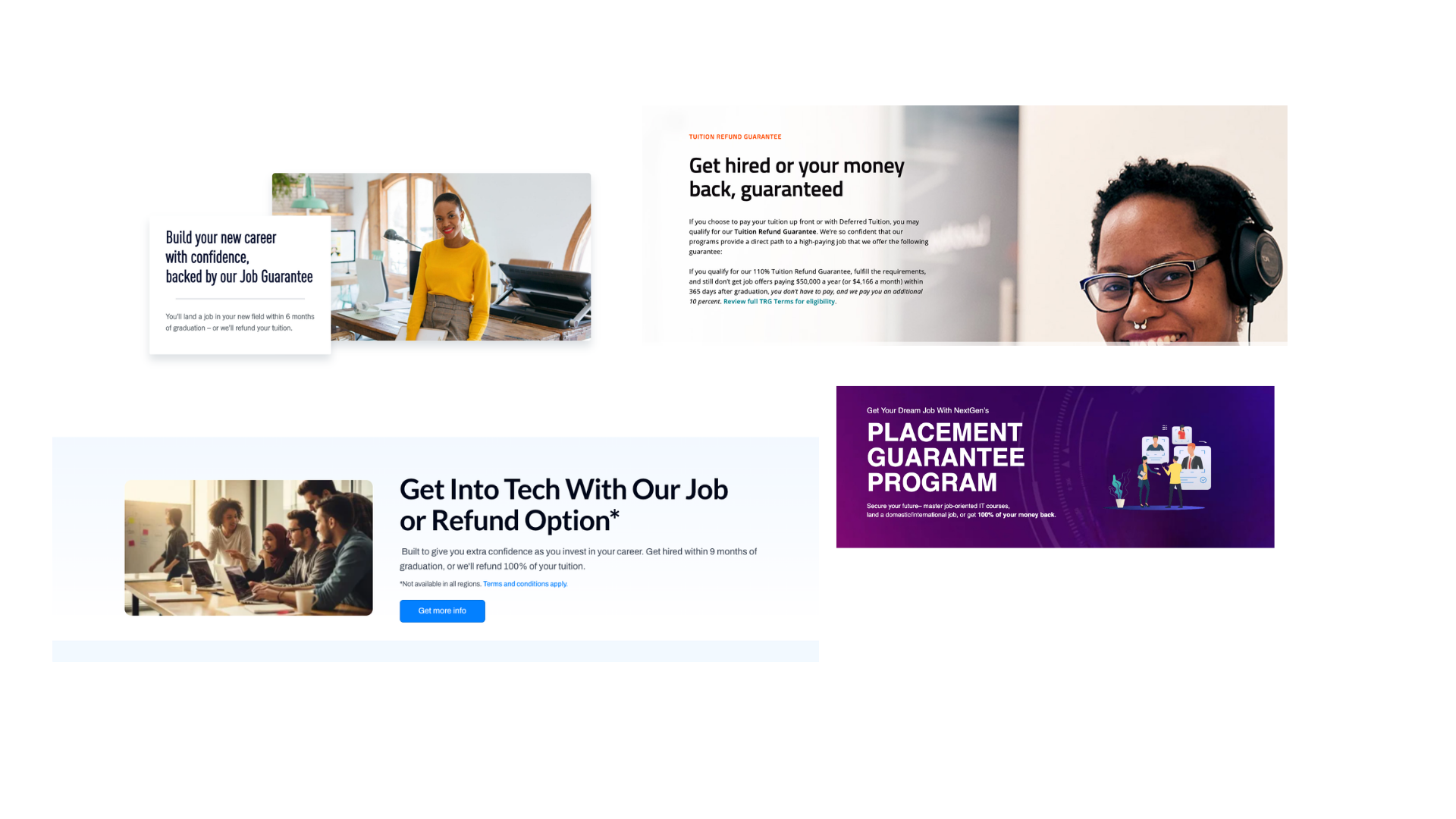
At the very least, online courses and certification programs need to provide a reasonable guarantee of improved skills and broadened opportunities after completion.
For a professional certification, transformation might mean the student can perform the skill confidently in realistic situations.
For a career change certification, it might mean they leave with both technical competence and a credible route into the profession.
For career change courses more broadly, it could mean helping students understand how their new capability translates into actual employment.
For a practitioner program, it might include supervised practice with real or simulated clients.
For entrepreneurship education, students might build and test the business while they're learning how to build it.
And for AI skills training, it could mean demonstrating that somebody can actually use AI effectively in their work rather than passing a multiple-choice quiz about prompt engineering.
The educational product therefore moves from:
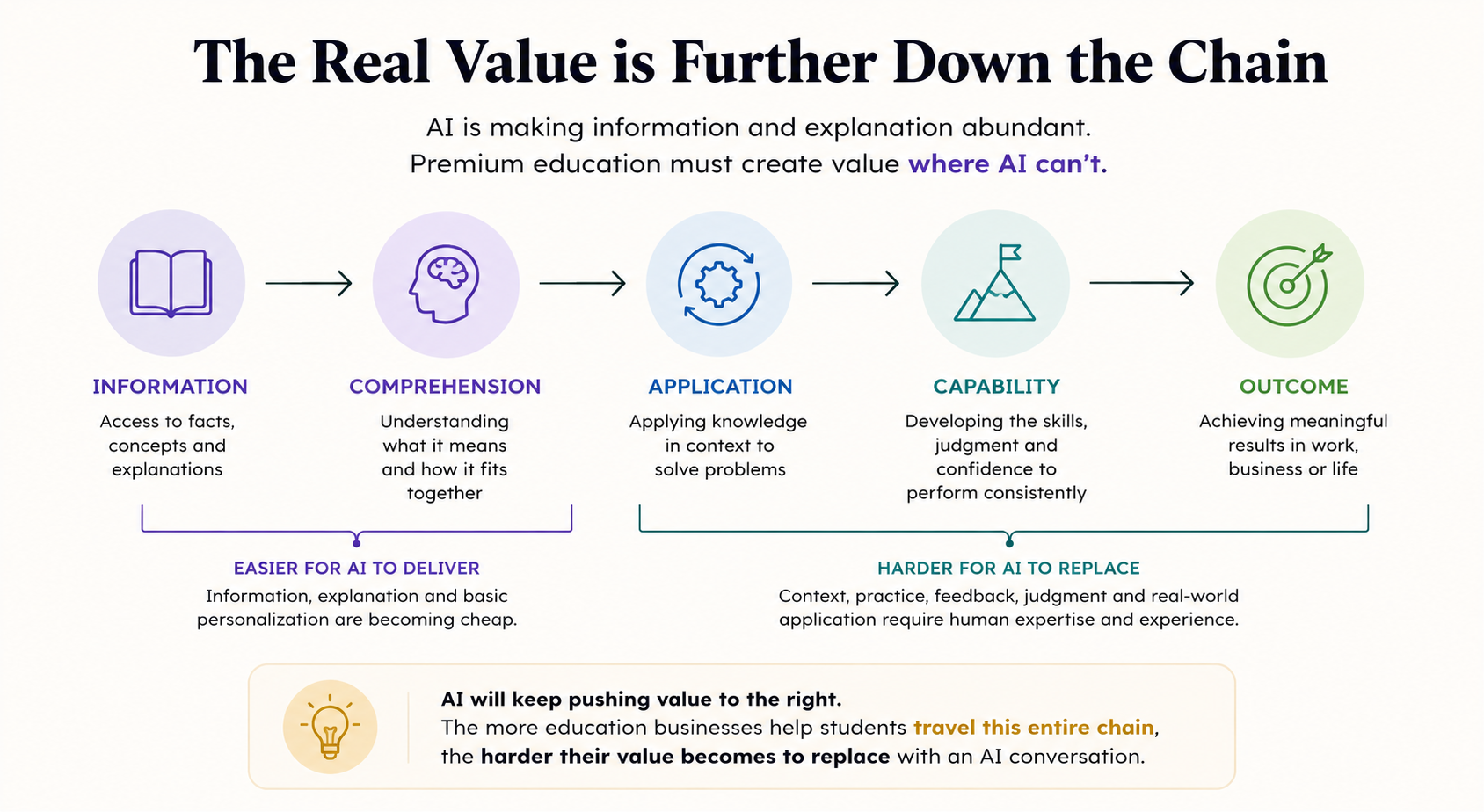
information → comprehension
toward:
information → comprehension → application → capability → outcome
AI makes this more urgent, not less
There's another reason this matters.
The labor market itself is changing quickly enough that simply possessing knowledge may become less durable.
The World Economic Forum's Future of Jobs Report 2025, based on responses from more than 1,000 employers representing more than 14 million workers, found employers expect 39% of workers' core skills to change by 2030.
AI and big data, networks and cybersecurity, and technological literacy were among the fastest-growing skill areas. But the same research also found increasing importance for distinctly human capabilities including creative thinking, resilience, flexibility, leadership and social influence.
That creates an interesting challenge for education providers.
If the useful life of some knowledge and technical skills is shortening, the value of a program can't depend entirely on transferring a fixed body of information.
Students may increasingly need to develop the ability to:
apply knowledge, make judgments, solve unfamiliar problems, adapt, evaluate information and continue learning.
That is a substantially different educational proposition from watching a library of videos.
And AI itself gives us an early clue
Interestingly, Coursera's own AI data gives us a small glimpse of what this could look like.
In its 2025 learner research, 94% of learners who used Coursera Coach, its AI-powered learning assistant, said it improved their learning experience. Reported benefits included making complex concepts easier to understand and making learning more interactive.
That doesn't prove AI tutors improve learning outcomes across online education. Coursera is reporting user perceptions of its own product, so we should treat the finding accordingly.
But it illustrates the competitive shift.
If an AI layer can increasingly help with:
explanation comprehension questions practice personalization
then the human and institutional value of an education provider gets pushed further toward the things AI cannot reliably provide alone.
Judgment.
Context.
Real-world practice.
Credibility.
Human feedback.
Accountability.
Experience.
Connection.
Transformation.
This changes course sales as well as course design
And this isn't merely a pedagogical argument.
It's a commercial one.
If why students choose online courses increasingly comes down to their confidence in the outcome rather than the quantity of content included, then the education provider that can make that transformation more believable has a fundamentally different value proposition.
That affects online course sales.
It affects online course enrollment.
And eventually, I think it affects the way we interpret an enrollment conversion rate.
Because when an education business sees declining course enrollment, it's tempting to immediately ask:
Is the sales page converting?
But the deeper question might be:
Do prospective students still believe this program will get them where they want to go?
Those are not the same problem.
And if student enrollment trends begin shifting toward programs offering stronger application, practice, accountability and demonstrable outcomes, education businesses won't be able to solve that simply by improving their marketing.
They will have to improve the product.
Which brings us to the next change I think we'll see:
The boundary between learning something and doing something with what you've learned is going to start disappearing.
And that means business, career and real-world implementation may need to move inside the curriculum itself.
3. Business and career implementation gets woven into the curriculum
If education providers are going to take more responsibility for transformation, then something else has to change.
The point at which students start applying what they've learned needs to move forward.
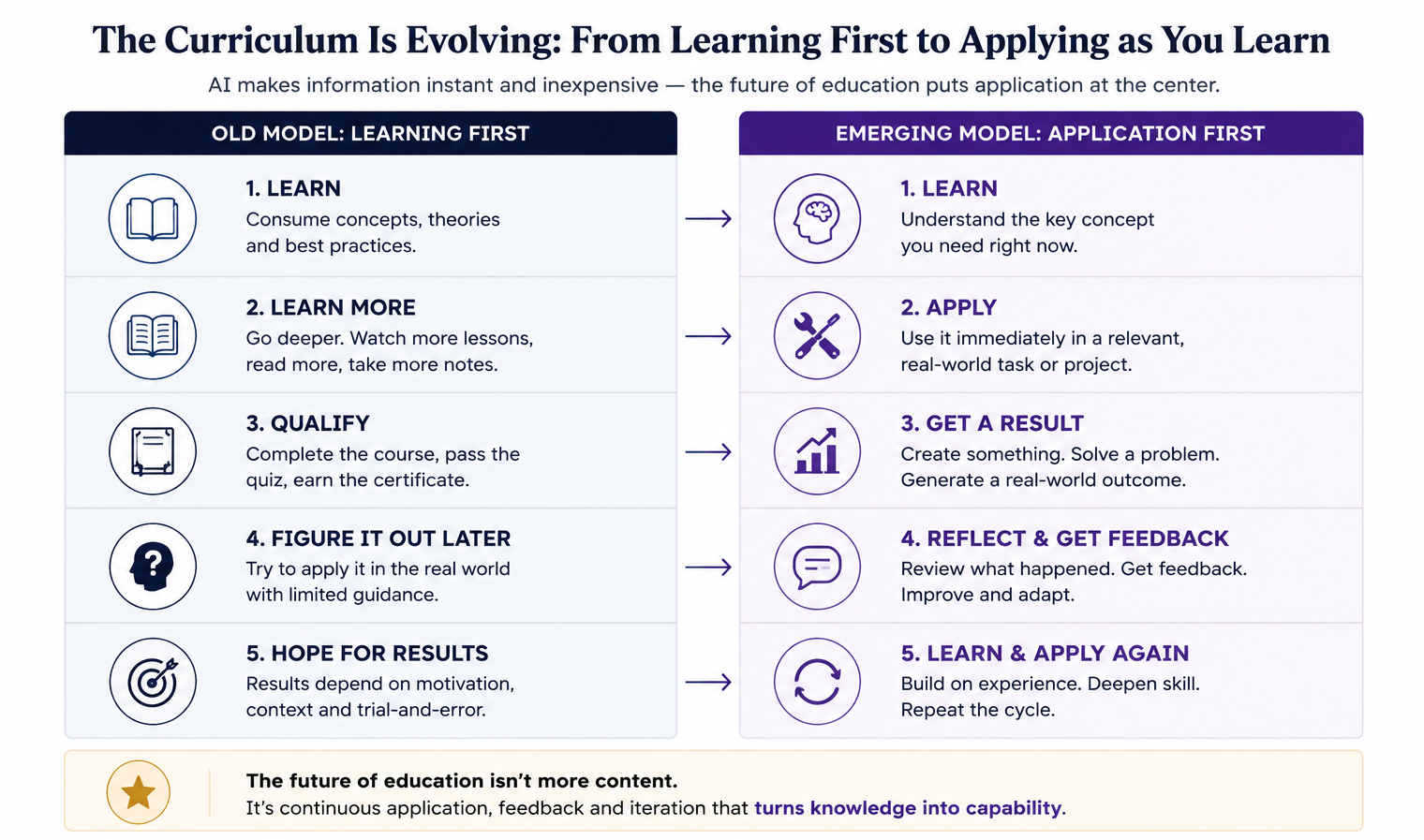
A lot of online education still follows a familiar sequence:
Learn → learn → learn → learn → qualify → now go and do something with it.
You complete the modules. You pass the assessments. You receive the certificate.
Then comes the slightly terrifying bit.
Now you have to figure out how to turn what you've learned into something real.
For somebody completing a career change certification, that might mean finding their first job in an unfamiliar industry.
For a newly qualified coach, therapist or wellness practitioner, it might mean finding their first client.
For somebody completing a business program, it might mean finally implementing the strategy they've spent six months learning.
For a technical learner, it might mean discovering that understanding a concept and solving a messy real-world problem with it are two very different things.
I think the future of online learning increasingly brings those two worlds together.
Instead of:
Learn → qualify → apply
we'll see more:
Learn → apply → produce a result → reflect → learn → apply again.
The application doesn't sit at the end of the education.
It becomes part of the education.
There is already evidence for learning through real-world application
This isn't purely a prediction.
There is an established body of research around authentic assessment, where learners are assessed through tasks that resemble the situations in which they'll ultimately need to use their knowledge.
A 2021 systematic literature review in Studies in Educational Evaluation examined 26 studies and found that authentic assessment can improve student engagement and satisfaction while contributing to employability skills including communication, collaboration, critical thinking, problem-solving, self-awareness and self-confidence.
A larger 2024 systematic review examined 94 studies and similarly concluded that authentic assessment can develop skills such as critical thinking, problem-solving and collaboration, while noting that implementation comes with challenges including training and resource requirements.
The important idea isn't that every online course needs to become a university assessment program.
It's much simpler:
People develop capability by doing things that resemble the thing they eventually need to be capable of doing.
That sounds painfully obvious when you write it down.
And yet plenty of education businesses still make students spend months learning about doing the thing before asking them to actually do it.
AI makes that distinction harder to ignore.
AI can help us know. Education needs to help us do.
This may become one of the most important divisions in AI and online education.
AI is extraordinarily well suited to parts of the learning process.
It can explain.
Summarize.
Generate examples.
Answer questions.
Quiz a learner.
Help someone practice.
Provide forms of feedback.
A 2021 systematic review of automatic feedback in online learning environments examined 63 studies and found that around 65% of the studies reported improved student performance in activities when automatic feedback was used. The authors were considerably more cautious about whether automated feedback reduced instructor workload, which is an important reminder that automation doesn't automatically make education operationally easier.
Modern generative AI is considerably more sophisticated than many of the systems covered in that 2009–2018 research period, so we shouldn't treat those findings as evidence about ChatGPT-era tutoring specifically.
But the direction is interesting.
Some parts of explanation, practice and feedback can increasingly be supported by technology.
Which potentially frees the education provider to concentrate human expertise where it creates more value.
Not:
Let me spend an hour telling 200 students information they could have consumed themselves.
But:
Show me what you've done with it.
Let's look at where you're struggling.
Here's what I would change.
Try it again.
Here's the nuance you're missing.
That is a very different role for the educator.
And potentially a much more valuable one.
Imagine the course where students build the outcome while they're learning
Take somebody training to become a coach.
In the traditional model, they might spend six months learning coaching frameworks, complete their assessments, qualify, and then confront an entirely new problem:
How do I become a working coach?
What if that transition began in month one instead?
They learn a technique.
They practice it.
They receive feedback.
They reflect on what happened.
They practice again.
They begin supervised work.
Alongside the practitioner training, they start learning what kind of clients they want to work with, how their practice might operate and what ethical, commercial and professional infrastructure they'll eventually need.
By graduation, they haven't merely learned coaching.
They have begun becoming a coach.
The same principle could apply to career change courses far beyond wellness.
Someone studying data analytics could work with messy real datasets rather than pristine classroom examples.
Someone learning UX could build a portfolio around actual problems.
Someone studying leadership could apply the material to situations inside their current workplace.
Someone completing AI skills training could use AI to redesign an actual workflow and measure what changed.
Someone learning entrepreneurship could validate an offer, speak to customers and make their first sale during the program rather than learning 17 frameworks about customer validation.
This is where I think the distinction between course completion and transformation becomes particularly important.
Maybe the first meaningful outcome shouldn't happen at the end
One of the questions I think education businesses should start asking is:
How quickly does a student experience evidence that this program is working?
Not necessarily a huge outcome.
A meaningful one.
If someone buys a twelve-month practitioner certification, does their first experience of competence happen in month eleven?
Or can they have an experience in week three that makes them think:
Holy shit. I can actually do this.
That matters psychologically.
It may matter educationally.
And I suspect it may eventually matter commercially too.
We need to be careful here because I haven't found sufficiently strong evidence to claim that engineering early real-world wins causes higher online course completion rates across education programs.
So I'm putting this firmly in our emerging hypothesis bucket rather than pretending the research has settled it.
But there's a question worth testing:
If students can see themselves becoming the person they enrolled to become while they're still inside the program, are they more likely to persist?
That feels considerably more interesting than simply asking how we get them to watch Module 6.
What helps students keep going?
Completion has long been one of online education's more stubborn problems.
Research into MOOCs has repeatedly found low completion rates, although the numbers vary substantially depending on the type of program, the learner's original intention and even how “completion” is defined.
A systematic review published in the International Review of Research in Open and Distributed Learning, for example, found that MOOC completion rates vary considerably and that factors including course design, interaction, learner motivation and support can influence whether students persist.
But comparing completion rates across different types of online education is difficult.
Someone casually enrolling in a free self-paced course is very different from someone paying several thousand dollars for a professional certification tied to a career change. Their motivation, financial commitment, selection process and definition of success may be completely different.
So rather than obsessing over one universal benchmark for online course completion rates, I think the more useful question for education businesses is:
What is present in a learning environment that makes someone more likely to keep going long enough to achieve the outcome they came for?
Structure may matter.
Accountability may matter.
Feedback may matter.
Peer relationships may matter.
Instructor presence may matter.
The perceived importance of the outcome may matter.
And, crucially, application may matter.
This is where cohort-based and hybrid models become interesting, not because “cohorts have an 85% completion rate” is some universal truth, but because they give us clues about the ingredients that purely self-paced education can sometimes lack.
They introduce deadlines, relationships, feedback, shared progress and moments when somebody notices whether you're actually doing the work.
The opportunity isn't necessarily to turn every online course into a cohort.
It's to understand which of those ingredients help students transform knowledge into action, and then design them intentionally into the learning experience.
Flexibility isn't the enemy of accountability
There's another tension here that education businesses need to solve.
Adult learners value flexibility for very good reasons.
They're often learning around jobs, children, businesses, relationships and the occasional minor inconvenience of having an actual life.
Online education solved a genuine accessibility problem by allowing people to learn asynchronously.
We shouldn't respond to poor persistence by dragging everyone back onto mandatory Zoom calls at 7 p.m. every Tuesday.
The more interesting online education trends may therefore involve hybrid models.
Hybrid learning, that is asynchronous material combined with synchronous workshops, office hours or cohort interactions, is becoming an increasingly important format, as is mobile learning and AI-supported personalization.
The design challenge becomes:
How do we preserve the flexibility people value while adding the structure, practice, feedback and human contact that help them turn information into capability?
That might mean fewer live teaching calls and more live practice.
Fewer lectures and more clinics.
AI tutors available whenever the learner needs explanation, with human experts available when they need judgment.
Peer groups organized around doing rather than consuming.
Projects that produce something genuinely useful.
Supervised practice.
Portfolio development.
Real client work where appropriate.
Simulations where real-world practice isn't yet safe.
The online course business model doesn't necessarily become more live.
It becomes more intentional about what should be asynchronous, what AI can support, and what genuinely deserves scarce human attention.
And this could change what premium education means
Historically, premium online education has often justified its price through more access.
More calls.
More content.
More bonuses.
More direct contact with the expert.
I'm not convinced that's where premium ultimately goes.
The premium may increasingly come from better-designed transformation.
Not:
Here's 70 hours of content instead of 20.
But:
We've designed an environment in which you repeatedly practice this skill, receive meaningful feedback, demonstrate competence and leave having already applied it in the world you're entering.
That's much harder to create.
It's also much harder for AI alone to replace.
And that could have significant implications for online course sales and online course enrollment.
Because when a prospective student compares a $200 information product with a $3,000 professional program, the premium program will increasingly need to make the additional value obvious.
Not through a longer curriculum list.
Through a more credible answer to:
What will I actually be able to do when this is over?
And for some students, particularly those using education to change careers, there's an even bigger question sitting immediately behind that one:
And can I actually build a viable life with it?
That's where I think this gets really interesting.
Because AI may not only change how people learn.
It may change what kinds of work people want to learn to do in the first place.
And that takes us to the next prediction:
4. That shift creates a huge opportunity for vocational, wellness and practitioner education, but changes what those providers need to sell
If even part of that prediction is right, there is an obvious opportunity for vocational, wellness and practitioner education.
But I don't think the opportunity is simply:
More people want to become coaches, therapists, massage practitioners, electricians or yoga teachers, so sell them more certifications.
The more interesting opportunity is to understand what those students are really buying.
Imagine someone who has spent fifteen years working in corporate marketing.
She's 39. She earns a decent salary. She has a mortgage. Perhaps she has children. She's increasingly convinced she doesn't want to spend the next twenty-five years doing the work she's doing now.
She's been thinking about retraining as a massage therapist.
The technical question is:
Where can I learn massage?
But that's probably not the question keeping her awake at 2 a.m.
The bigger questions are:
Can I actually make a living doing this?
How long will it take before I can earn?
How do I get my first clients?
Will anyone take me seriously when I've just qualified?
What if I spend thousands retraining and discover I can't make it work?
Am I completely insane for leaving a career I've spent fifteen years building?
That student isn't simply buying education.
She's buying a transition.
And I think that distinction will become increasingly important to the future of professional certification.
The value of the qualification depends partly on what happens next
There is already evidence that career outcomes matter enormously to online learners.
Coursera's 2025 Learner Outcomes Report found that 86% of learners came to the platform to build new skills and transform their careers. Nearly three quarters, 73%, identified gaining skills for career advancement as their primary motivation.
Among learners who completed a course or program, 91% reported at least one positive career outcome, while 46% reported a salary increase since enrolling and 27% reported moving to a higher job level. Those are self-reported outcomes from Coursera learners, so they shouldn't be treated as universal benchmarks for professional education. But they tell us something important about how learners themselves perceive the value of education.
They're connecting learning to what happens in their lives and careers afterwards.
For somebody pursuing a career change certification, that connection is even more consequential.
The student's desired outcome isn't:
I completed a certification.
It's closer to:
I became a practitioner.
And there can be an enormous gap between those two things.
The qualification may only solve half the problem
Consider what happens to many students after graduating from a practitioner program.
They may know the methodology.
They may have passed the assessment.
They may have completed the required practice hours.
They may be officially qualified.
And then...
Now what?
How do I find clients?
What should I charge?
Where do I practice?
Do I need insurance?
How do I explain what I do?
Should I specialize?
How do I know whether I'm ready?
How do I turn three clients into ten?
What if nobody books?
The education provider might reasonably say:
We're a training organization. Teaching you how to build a business isn't our job.
And historically, that may have been enough.
I think it will become less enough.
Not because every training provider suddenly needs to become a business incubator.
But because students comparing programs may increasingly judge them by the probability of achieving the ultimate outcome they're buying.
If two schools can both teach me the technical skill, but one can credibly show me a pathway from:
interested beginner → competent practitioner → supervised experience → first clients → functioning practice
then those aren't really equivalent products anymore.
This is particularly interesting in wellness
There is already substantial economic activity around health and wellness coaching.
Grand View Research estimated the global digital health coaching market at approximately $10.99 billion in 2024, projecting it to reach about $22.06 billion by 2030, a compound annual growth rate of 12.5% from 2025 to 2030.
Within that market, its estimates put holistic health coaching at approximately $4.49 billion in 2024, with a projected value of $9.27 billion by 2030. Nutrition and diet coaching accounted for about $2.44 billion in 2024.
Those numbers describe the market for coaching services rather than the market for training health coaches, so we shouldn't confuse the two.
But they matter to training providers for a different reason.
They're part of the economic environment graduates are trying to enter.
If I'm considering spending several thousand dollars qualifying for a new profession, I'm not only evaluating the curriculum.
I'm evaluating the opportunity on the other side of it.
That makes the graduate outcome part of the enrollment proposition, whether the education provider chooses to acknowledge it or not.
The strongest programs may start de-risking the transition
This is where I think the product itself begins to change.
A future practitioner certification might not stop at:
Learn the methodology → demonstrate competence → qualify.
It could extend into:
Learn → practice → demonstrate competence → qualify → establish yourself → begin practicing professionally.
Different professions will require completely different versions of this.
For a massage school, it could include supervised clinics, guidance on setting up a practice, relationships with spas or wellness businesses, or pathways into employment.
For a coaching certification, it might include supervised client hours, positioning a practice, ethical client acquisition and support securing the first few clients.
For a yoga teacher-training program, it could include teaching real classes, developing a teaching portfolio and introductions to studios.
For a trade school, the equivalent might be apprenticeships, employer relationships or placement support.
For professional career change courses, it could mean portfolio development, interview preparation, work placements, real-world projects or employer introductions.
The point isn't that every provider should bolt “business coaching” onto the end of a qualification.
It's that the program should understand the next obstacle the student encounters after becoming competent.
Because increasingly, that obstacle may determine whether the education feels transformative or merely informative.
This doesn't mean guaranteeing outcomes
There is an obvious danger here.
Once education businesses start talking about employment, income, clients and career outcomes, it's easy to slide into promises they can't responsibly make.
Become a coach and earn six figures!
No, Susan.
We're not doing that.
There are too many variables outside an education provider's control.
Economic conditions matter.
Geography matters.
The student's effort matters.
Their existing skills and network matter.
Their chosen profession matters.
Luck matters.
But there's a huge space between guaranteeing the outcome and washing your hands of the outcome entirely.
A provider can ask:
What tends to stop our graduates succeeding after qualification?
Which of those barriers can we reasonably help remove?
What experience do employers or clients expect that our graduates currently lack?
Where do students lose confidence?
What additional support meaningfully improves their ability to make the transition?
What do our successful graduates do differently?
That turns graduate outcomes into a product-design question rather than a marketing claim.
And eventually, education businesses may have to measure this
This is where things become particularly interesting from a commercial perspective.
Most education businesses are very good at measuring the beginning of the student journey.
Traffic.
Leads.
Applications.
Calls.
Course sales.
Student enrollment.
Revenue.
Perhaps they track their enrollment conversion rate obsessively.
But what happens further downstream?
How many students start?
How many progress?
How many finish?
How many become competent?
How many actually use the qualification?
How many get employed?
How many start practicing?
How many acquire their first client?
How many are still using the skill twelve months later?
The answer will depend enormously on the kind of education being delivered, and not every outcome can or should be reduced to a neat dashboard metric.
But I suspect this becomes an increasingly important part of student enrollment trends over time.
Because prospective students don't experience an enrollment funnel as a funnel.
They experience it as a decision.
Do I believe spending this money will get me where I want to go?
That belief influences why students choose online courses, certifications and training programs.
It influences perceived risk.
It influences willingness to pay.
And ultimately, it influences online course sales and online course enrollment.
Graduate outcomes could become an acquisition advantage
This creates an interesting commercial loop.
Imagine two certification providers.
Provider A says:
Our certification contains 120 hours of comprehensive training across 14 modules.
Provider B says:
82% of graduates from last year's cohort were actively practicing within twelve months.
Assuming that second number is measured honestly, and the programs are otherwise comparable, which one gives the prospective student more useful information?
The curriculum still matters.
The credential still matters.
The quality of teaching still matters.
But evidence of what happens to people afterwards may become one of the strongest forms of trust an education provider can create.
That changes marketing too.
Instead of testimonials that say:
I loved the course and Sarah was amazing!
we may see much more systematic evidence around:
competence achieved portfolio created practice hours completed employment outcomes businesses launched clients acquired income changes career transitions professional confidence continued use of the qualification
Not every transformation is financial, of course.
In personal development, health and other transformation-led education, the outcome might involve health, relationships, confidence, behavior or quality of life.
The principle remains the same:
Measure the thing the student actually came to change.
Perhaps the real product is no longer the course
This is where the online course business model starts becoming more interesting.
If the student's desired outcome extends beyond acquiring information, the product may eventually need to extend beyond content too.
Education.
Practice.
Community.
Mentorship.
Tools.
AI support.
Human feedback.
Career services.
Business support.
Ongoing professional development.
Graduate networks.
Employer or industry connections.
Not every business needs all of them.
But the strongest education businesses may increasingly behave less like companies selling courses and more like ecosystems designed around a particular transformation.
That's potentially good news for premium education.
AI may destroy some of the scarcity around information.
It doesn't necessarily destroy the scarcity around successfully becoming something.
In fact, it may make the difference between those two things much easier for students to see.
And if that's right, the education categories that thrive won't necessarily be the ones with the most content.
They'll be the ones where the value is hardest to reduce to information in the first place.
Which raises the next question:
Which kinds of education become more valuable in an AI-saturated world, and which become much harder to sell?
5. Some education categories will become more valuable while generic information products become less defensible
If AI changes the economics of information, it follows that it won't affect every category of education equally.
Some programs are much more exposed than others.
A course whose primary value is:
I'll explain something you don't know.
has a very different future from a program whose value is:
I'll help you become capable of doing something difficult, valuable or professionally recognized.
That's why I don't think the future of online courses can be reduced to whether people will continue buying courses.
They will.
The more useful question is:
What will they still be willing to pay meaningful amounts of money to learn?
And my prediction is that the market increasingly separates according to how much of the educational value AI can commoditize.
The most exposed category: information-only education
Start with the obvious one.
A significant proportion of online education has historically been built around information asymmetry.
The expert knows how to do something.
The student doesn't.
The expert packages that knowledge into a course.
That information gap is what makes the transaction valuable.
Generative AI dramatically reduces the gap.
Suppose I want to learn how to create a basic marketing plan.
Or understand SEO.
Or use a common piece of software.
Or learn the fundamentals of social media advertising.
Or create a meal-planning system.
Or understand a common business framework.
I can already ask AI to teach me many of these things.
More importantly, I don't have to accept its first explanation.
I can ask:
Explain it more simply.
Build me a learning plan.
Give me an example for my industry.
Quiz me.
Create an exercise.
Look at what I've produced and tell me what's missing.
Now help me apply it.
That doesn't make AI equivalent to a genuine expert, and there are plenty of subjects where relying on an AI system without qualified supervision would be stupid or dangerous.
But it does mean the perceived value of introductory information is under pressure.
This is particularly relevant to generic business education, basic software training, introductory knowledge products and courses where the curriculum itself is the primary reason to buy.
For education businesses in those categories experiencing declining course sales, the instinct may be to immediately ask how to increase online course sales.
Improve the sales page.
Change the webinar.
Run different ads.
Add bonuses.
Drop the price.
Create more urgency.
Those things might improve a genuine course conversion rate problem.
But they won't necessarily solve a value problem.
If prospective students believe they can achieve a sufficiently similar outcome elsewhere for little or no money, the problem isn't simply that your funnel stopped converting.
The market may have changed underneath the funnel.
That doesn't mean cheap courses disappear
There is an important distinction here.
Information becoming cheaper doesn't mean nobody will pay for organized information.
I happily pay for books despite having access to Google.
Convenience has value.
Curation has value.
Structure has value.
Knowing which information to ignore has value.
Trusting the person who assembled it has value.
And plenty of people would rather pay $50 for a clear learning pathway than spend fourteen hours having an increasingly deranged conversation with an AI trying to work out what they should learn next.
So low-cost, self-paced education isn't necessarily doomed.
It may simply occupy a different position in the market.
Information-heavy courses could increasingly function as:
low-cost products introductions to a subject structured learning pathways lead products membership content companions to AI learning prerequisites for higher-value experiences
The pressure is likely to be greatest when an information product wants to command a premium price simply because the information used to be difficult to access.
That scarcity is disappearing.
Category 1: Education that teaches people to work with AI
The most obvious beneficiary of technological disruption is education about the technology itself.
The World Economic Forum's Future of Jobs Report 2025 identifies AI and big data as the fastest-growing skills through 2030, followed by networks and cybersecurity and technological literacy.
And the reskilling requirement is substantial. The WEF estimates that 59 out of every 100 workers will require training by 2030, while 63% of employers already identify skills gaps as a major barrier to transformation.
That creates obvious demand for AI skills training.
But I think there is an important distinction within this category too.
Generic courses called something like:
The Ultimate Guide to ChatGPT
may themselves become rapidly commoditized.
The more durable opportunity may be highly contextual education:
AI for accountants AI for lawyers AI for marketers AI for healthcare administrators AI for educators AI for small-business operators
Because the valuable question moves from:
How does AI work?
to:
How do I use it competently, safely and effectively in the work I actually do?
The technology changes quickly.
The application problem is much more specific.
Category 2: Education where the credential matters
AI also doesn't remove the need for credible qualification.
In many professions, you can't simply tell an employer, regulator or client:
Don't worry, ChatGPT says I'm excellent.
There are fields where training exists partly because society needs a credible way of establishing whether somebody is sufficiently competent to perform a role.
Healthcare is the obvious example, but the principle extends across many regulated, licensed and professionally recognized occupations.
This is where online certification trends become particularly interesting.
As information becomes abundant, credible verification of capability may become more valuable rather than less.
The credential says:
Somebody other than this person has assessed their competence against a defined standard.
That creates a fundamentally different value proposition from a generic information course.
It also means the future of professional certification may depend increasingly on the quality of what the credential actually verifies.
Did the learner watch the required content?
Did they remember enough to pass a test?
Or can they demonstrate the capability the qualification is supposed to represent?
AI makes that distinction more important because producing answers, assignments and even substantial pieces of written work has become dramatically easier.
A credential built primarily around proving that somebody can reproduce information may therefore become less meaningful.
A credential built around demonstrated capability is much harder to commoditize.
Category 3: Education built around physical and embodied capability
Then we have the categories we explored in the previous section.
You cannot become a competent massage therapist by knowing everything there is to know about massage.
You have to touch bodies.
You cannot become a carpenter by understanding wood.
You have to build things.
You cannot become a yoga teacher solely by memorizing anatomy and sequencing.
Eventually, you have to teach human beings.
You cannot become an excellent counsellor simply by knowing counselling theory.
You need to develop interpersonal judgment and practice applying it appropriately.
AI can support education in all of these fields.
It can explain anatomy.
Generate scenarios.
Help students revise.
Simulate conversations.
Answer questions.
Potentially provide increasingly sophisticated practice environments.
But there remains a point where knowledge has to become embodied capability.
That creates a degree of defensibility for vocational, practitioner and experiential education that purely informational courses don't necessarily possess.
And the wider employment outlook gives us reason to take these categories seriously. The WEF projects substantial absolute job growth in construction, care, education and other frontline occupations through 2030, alongside the rapid growth of technology roles.
Again, this isn't evidence that AI is sending knowledge workers into those professions.
But it does tell us that the future economy won't consist solely of digital jobs.
Category 4: Education tied tightly to a real-world outcome
This may be the most important category of all.
The stronger the relationship between the education and an outcome the student deeply values, the more defensible the program becomes.
That outcome could be:
getting a job changing career becoming professionally qualified starting a practice winning clients building a portfolio achieving competence passing a regulated assessment improving health changing a behavior creating something tangible
This doesn't mean slapping an outcome claim onto the sales page.
Become a certified practitioner in 12 weeks!
isn't automatically a stronger product than:
Learn practitioner skills in 12 weeks!
The question is whether the program is actually designed around producing the outcome.
That's where the reason why students choose online courses becomes inseparable from course design.
If students become increasingly skeptical about paying for information, they may become more interested in evidence that the program can help them cross a meaningful gap.
And that affects both online course sales and course enrollment.
Category 5: Education built around human capabilities
There's one more category I think deserves much more attention.
The skills employers expect to matter in an AI-heavy economy aren't exclusively technical.
The World Economic Forum still identifies analytical thinking as the most sought-after core skill among employers, while creative thinking, resilience, flexibility and agility, curiosity and lifelong learning, leadership and social influence are all expected to increase in importance through 2030.
This gives us an interesting paradox.
The more sophisticated technology becomes, the more valuable some distinctly human capabilities may become alongside it.
Judgment.
Leadership.
Communication.
Creativity.
Relationship-building.
Adaptability.
Teaching.
Mentoring.
The WEF itself describes the future skills requirement as a combination of technological and human skills rather than a replacement of one with the other.
That potentially creates a substantial opportunity for education businesses.
But again, these capabilities can't be developed particularly well by giving someone 37 videos about leadership.
If human capability becomes the product, the learning experience needs to let people practice being human.
That means feedback.
Interaction.
Reflection.
Complex situations.
Other people.
Real consequences.
Which takes us straight back to the transformation argument.
We may be heading towards five different value propositions
Put all of this together, and I think a useful model starts to become clear.
The online education trends worth watching aren't simply which subjects get more Google searches next year.
They're about the underlying reason education remains valuable when information is abundant.
We could think about the market in five broad categories:
AI-complementary education Teach me to use new technology effectively in my actual work.
Credential-dependent education Give me credible evidence that I am capable or qualified to do something.
Embodied and human education Help me develop capabilities that require practice, judgment, interaction or physical experience.
Outcome-transition education Help me cross the distance between where I am now and a meaningful professional or personal result.
Information-only education Give me access to knowledge I don't currently possess.
I don't think the fifth category disappears.
But I do think it becomes increasingly difficult to defend at premium prices.
And that has consequences for the online course business model.
The middle of the market could become an uncomfortable place to be
One possible outcome is increasing polarization.
At one end:
cheap, excellent, abundant information.
AI tutors.
YouTube.
Books.
Low-cost courses.
Subscriptions.
Open educational resources.
At the other:
high-value transformation.
Qualifications.
Expert feedback.
Real-world projects.
Supervised practice.
Community.
Career pathways.
Human access.
Demonstrated outcomes.
The uncomfortable place may be the middle:
A $1,500 information product containing prerecorded videos, a Facebook group nobody uses and three bonuses that could comfortably have remained Google Docs.
That doesn't mean those products vanish overnight.
But their value proposition becomes much harder to explain.
And this is why education businesses need to be careful when interpreting changes in their enrollment conversion rate.
If online course enrollment falls, there are multiple possible explanations.
Perhaps traffic changed.
Perhaps the audience changed.
Perhaps the sales journey developed friction.
Perhaps competitors improved.
Perhaps pricing changed.
But increasingly there is another possibility:
The thing students believe is worth paying for has changed.
No amount of conversion optimization can permanently solve that.
The real question isn't “Will AI replace courses?”
It's:
Which parts of education become cheap because of AI, and which parts become more valuable because of it?
I think information gets cheaper.
Explanation gets cheaper.
Basic personalization gets cheaper.
Some forms of practice and feedback get cheaper too.
But transformation doesn't automatically get cheaper.
Neither does competence.
Neither does credible assessment.
Neither does human trust.
Neither does supervised experience.
Neither does successfully changing careers, building a practice or becoming capable of doing something difficult in the real world.
And that is why I'm considerably more optimistic about the future of online education than the “AI will kill courses” narrative suggests.
I don't think we're watching education disappear.
We're watching the market renegotiate what education is actually worth paying for.
And if that's true, the next question isn't only what education businesses should teach.
It's what the learning experience itself needs to become.
Because the student expectations emerging from an AI-saturated world may be very different from the expectations that built the first generation of online courses.
So what does the future of online courses actually look like?
AI creates a strange tension for education.
We are likely to need to learn more often as technology changes our jobs, industries and careers. But we'll have less reason to pay simply for access to information.
That doesn't make me pessimistic about the future of online courses. Quite the opposite.
I think it forces education to get better.
The value moves from what the student knows toward what the student becomes capable of doing.
That means more application. Better feedback. Real-world practice. Credible assessment. Accountability. Human judgment. Career and business implementation where relevant. And much greater attention to whether students actually achieve the transformation they enrolled for.
For education businesses, that may eventually expand the journey we pay attention to:
Acquisition → Enrollment → Progression → Completion → Transformation → Graduate outcome
Because what happens after enrollment doesn't stay after enrollment forever.
Great outcomes create reputation, referrals, trust and evidence. Poor outcomes eventually make the next student's decision harder.
And that's why I think the most important question for any course, certification or training provider in the AI era is this:
What happens to the person because they came through your program that wouldn't have happened if they'd simply asked AI to teach them the subject?
If the answer is mainly they know more, I'd be nervous.
If the answer is they're capable of something they couldn't do before, that's much more interesting.
AI won't kill online education. It will expose how much online education was never really education in the first place.
The future isn't more information.
It's helping people actually become capable of doing something different with what they know.
Not sure whether your program is selling information or transformation?
That's the question the Enrollment Diagnostic is built to answer.
We look at how prospective students experience your program, where they hesitate, and what they believe they're actually paying for, so you can decide what to change before the market decides for you.
About the author

Hanna-Mari Kirs
Founder & Strategist, Heroes & Guides
Hanna-Mari is an enrollment strategist researching how online educators, certification providers and course creators can improve student enrollment conversion through clearer enrollment journeys, decision-making psychology and website strategy.