Report · July 2026
Online Certification & Training Statistics (2026)
Last updated: July 2026
Discover online course conversion rate benchmarks, enrollment statistics, market data and student insights for certification programs and training providers.
This report is designed as a practical reference for founders, CEOs, marketers and enrollment teams of transformation-led education organisations. Use it to benchmark your organization online course conversion rate, understand student decision-making and identify opportunities to improve enrollment journeys. Benchmarks provide context, not targets.
What's included
- Certification programs
- Coaching schools
- Practitioner training
- Leadership development academies
- Professional development providers
- Premium online training organisations
What's excluded
- Traditional universities
- Degree programs
- K–12 education
- Large course marketplaces unless broadly applicable
About this report
This is intended to be a living industry reference. It will be updated as new research, benchmarks and original findings become available.
Table of Contents
- 01. Market Overview & Industry Context
- 02. Online Course Enrollment & Website Benchmarks
- 03. What Prospective Certification Students Are Really Looking For
- 04. Research Insights for Education Founders
- 05. Where the Transformation-Led Education Industry Is Heading
- 06. Key Takeaways
- Methodology
- References
01. Market Overview & Industry Context
The online education market is enormous, but not all online education is created equal.
When you search for statistics about online learning (let's say you wanted to know the average certification program enrollment rate), you'll find they often combine universities, corporate learning, MOOCs, compliance training and professional certifications into one market. While the insights can be useful at a macro level, those figures don't really represent the organisations that this current report focuses on.
Throughout this report, we're specifically looking at transformation-led education: certification programs, coaching schools, practitioner training, leadership academies, professional development providers and premium online training organisations that help people build new careers, develop professional identities or create meaningful change in their lives.
That distinction matters because the motivations, buying behaviour and enrollment journeys in this space are fundamentally different from traditional higher education.
What Is Transformation-Led Education?
Despite economic uncertainty (and I suspect in some ways because of it), demand for professional learning and wellness-focused education continues to grow.
Transformation-led education spans certification programs, coaching schools, practitioner training, leadership academies and premium online training organisations. What ties them together is that students aren't just learning a skill — they're preparing to become a practitioner, a coach or a professional in a new field.
Market Growth & Industry Size
One of the challenges with researching this sector is that there is no single industry called transformation-led education.
Instead, certification providers operate within multiple overlapping markets.
Some examples include:
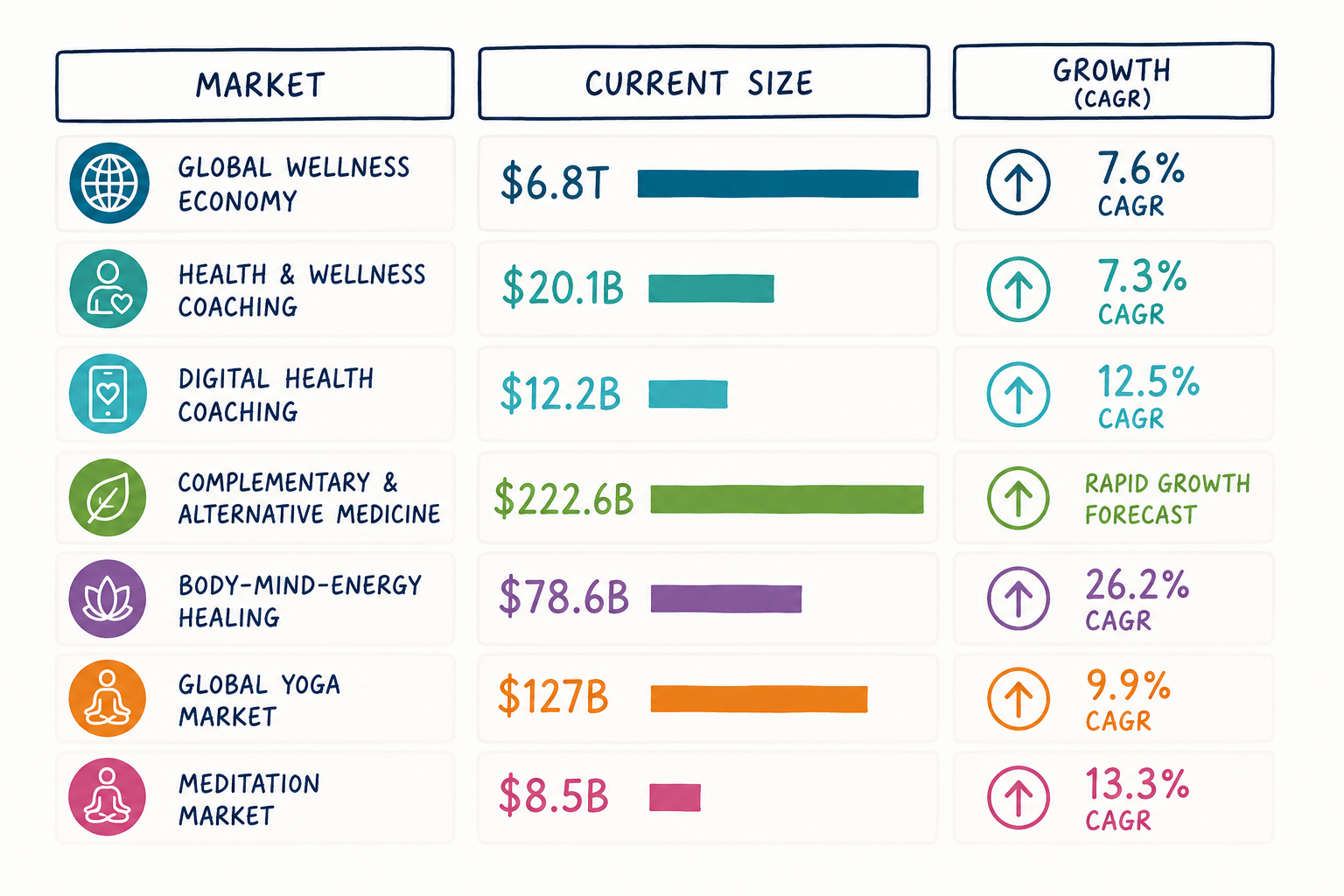
Sources: Global Wellness Institute, Precedence Research / CoachTrainingEdu, Grand View Research, Coherent Market Insights
Taken together, they represent a huge and rapidly expanding ecosystem of people investing in health, wellbeing, personal growth and professional transformation.
The Wellness Economy
According to the Global Wellness Institute, the global wellness economy reached $6.8 trillion in 2024, representing approximately 6.1% of global GDP. The organisation projects annual growth of 7.6%, with the market expected to approach $9.8 trillion by 2029.
For comparison, the Global Wellness Institute notes that the wellness economy is bigger than IT, the green economy and tourism.
At the same time, McKinsey estimates the global consumer wellness market alone to be worth $1.8 trillion, with the United States accounting for approximately $480 billion and growing at around 10% annually.
For online certification providers, this is an important distinction. You're not competing inside a shrinking or saturated industry. You're actually operating within one of the fastest-growing consumer sectors globally.
Why Market Growth Doesn't Guarantee Easier Enrollment
Growing markets create opportunity, but they also create competition.
As more organisations launch certification programs, students have more choice than ever before. Increasing enrollment is becoming less about simply attracting traffic and more about helping your students confidently choose your program over countless alternatives.
That is why understanding how your students evaluate certification programs has become just as important as understanding the market itself.
Because ultimately, students don't enroll in industries.
They enroll in organisations they trust.
One of the strongest themes emerging from both published research and our own research is that many certification students aren't starting from zero.
They're often already practising yoga.
Already fascinated by nutrition.
Already working in healthcare.
Already coaching informally.
Already using complementary therapies in their own lives.
Certification is often the point where a personal interest becomes a professional identity, and published research supports this conclusion.
Studies of students entering complementary and alternative medicine (CAM) programs found they were significantly more likely to already use alternative health approaches themselves and identify with holistic values before beginning formal training.
In other words, many students don't discover these professions through education.
They discover education after they've already begun working with these practices.
Why it matters
Most prospective students are not asking:
Can I learn this?
They're asking:
Could this become my future?
And more specifically, can I make a sustainable living doing this?
That shift changes how certification providers need to think about their websites, messaging and enrollment journeys.
02. Online Course Enrollment & Website Benchmarks
Once we understand the market, the next question becomes:
How do you know whether your own enrollment journey is performing well?
This is where benchmarking becomes useful.
Not because another organisation's numbers should become your targets, but because they give you context. They help you spot opportunities, ask better questions and understand whether you're in roughly the right ballpark.
Online Course Conversion Rate Benchmarks
It's probably the most common question I hear.
"What's a good conversion rate for a certification program?"
And, as you might have guessed, the answer is: it depends.
A program with a strong founder brand, an engaged email list and a loyal community will almost always convert differently than a business relying entirely on paid advertising.
Likewise, a self-paced $49 course is a very different buying decision from a $3,000 practitioner certification.
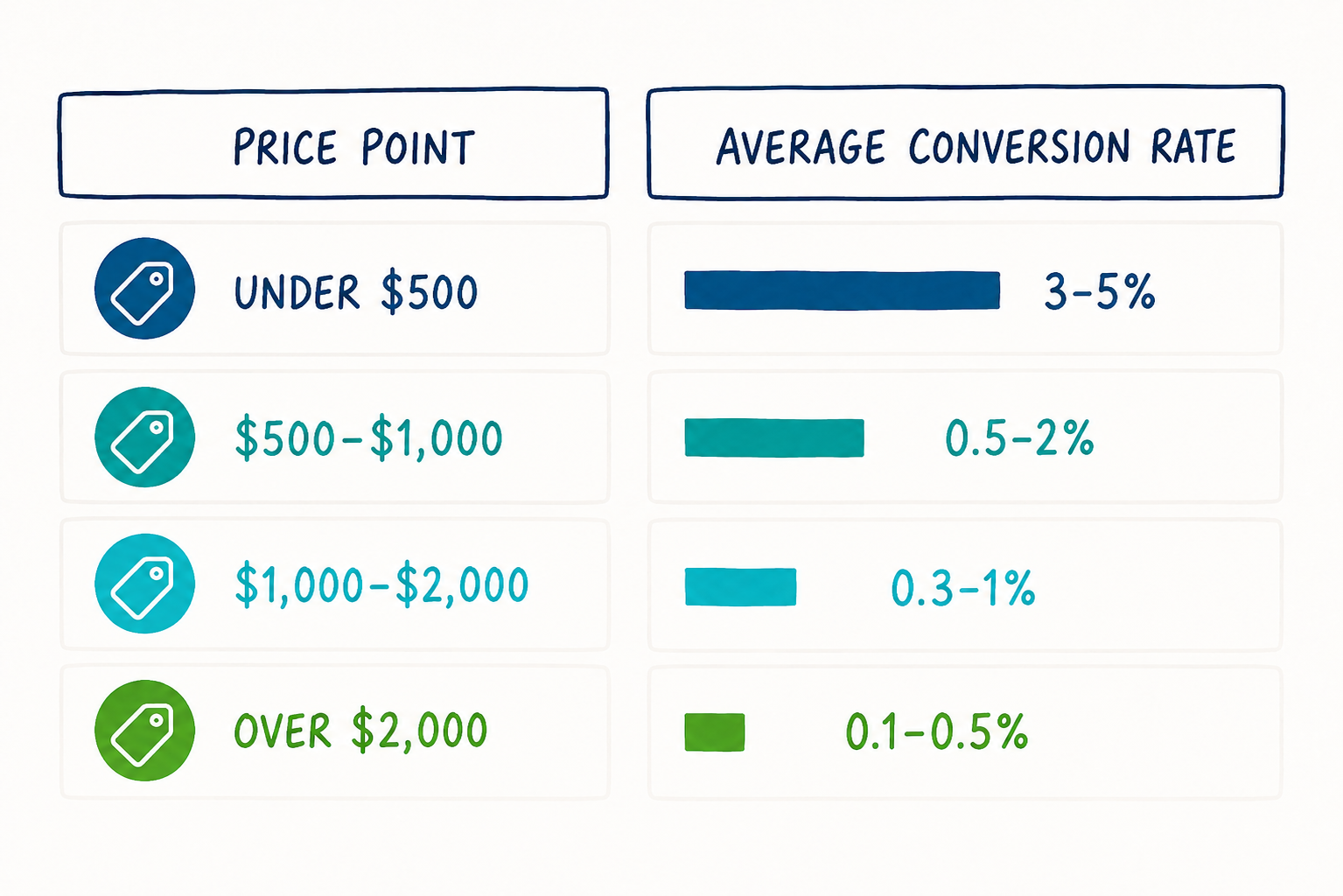
Source: Acceleroi
Why it matters
One of the biggest mistakes I see is organisations comparing themselves to completely different business models.
A 1% conversion rate isn't automatically "bad."
If you're selling a premium certification with a long decision-making process, a high average order value and a strong alumni network, that same conversion rate could support a very healthy, sustainable business, especially if the lifetime value of a single customer expands well beyond their first purchase (think advanced certifications, membership programs etc).
Want to see how your own enrollment numbers compare?
I've created a free Enrollment Health Calculator to help you benchmark your numbers based on your program value, enrollment pathway and where your website traffic comes from.
Calculate Your Enrollment Health →Website Engagement Benchmarks
Conversion rate gets most of the attention, but it rarely tells the whole story.
A lower-than-expected conversion rate might be caused by:
- visitors leaving too quickly
- unclear messaging
- poor navigation
- missing information
- a lack of trust
- pricing uncertainty
- too many competing pathways
Or it might simply reflect a longer buying journey.
That's why it's useful to look at a handful of metrics together rather than obsessing over one percentage.
Some of the most helpful include:
- Conversion rate – What percentage of visitors eventually enroll?
- Bounce rate – Are visitors leaving immediately or exploring further?
- Average engagement time – Are people actually reading your content?
- Pages per session – How much of your website are they exploring?
- Call-to-action click-through rate – Are people taking the next step?
- Lead-to-enrollment rate – How many enquiries become enrolled students?
Taken together, these metrics tell a much richer story about how prospective students experience your enrollment journey.
Don't have these website & enrollment numbers?
You might not be hanging out in your company's Google Analytics dashboards every day (most founders I meet, don't), but it pays to have a look at or ask your team for the following stats for your business:
- The overall website conversion rate
- The conversion rate for each certification program
- Your highest-traffic pages
- Which pages have the highest bounce rates
- How long do people spend on key enrollment pages
- Where most of the enquiries come from (Google, referrals, email, social media, podcasts, paid ads etc.)
- Where your students tend to drop off before enrolling
- Mobile vs desktop traffic
If you're looking for a quick overview, Similarweb can provide some of these metrics for free, without you needing to dig through Google Analytics.
Once you have your monthly website traffic, enrollment revenue and average program value, you can plug them into the Enrollment Health Calculator to get a quick benchmark for your business.
Calculate Your Enrollment Health →Traffic Source Benchmarks
Much also depends on the quality of your traffic. Organic search (people knowing you and searching for your brand online) vs cold traffic (first-time visitors landing on your site through ads, for example) also tend to yield different conversion results.
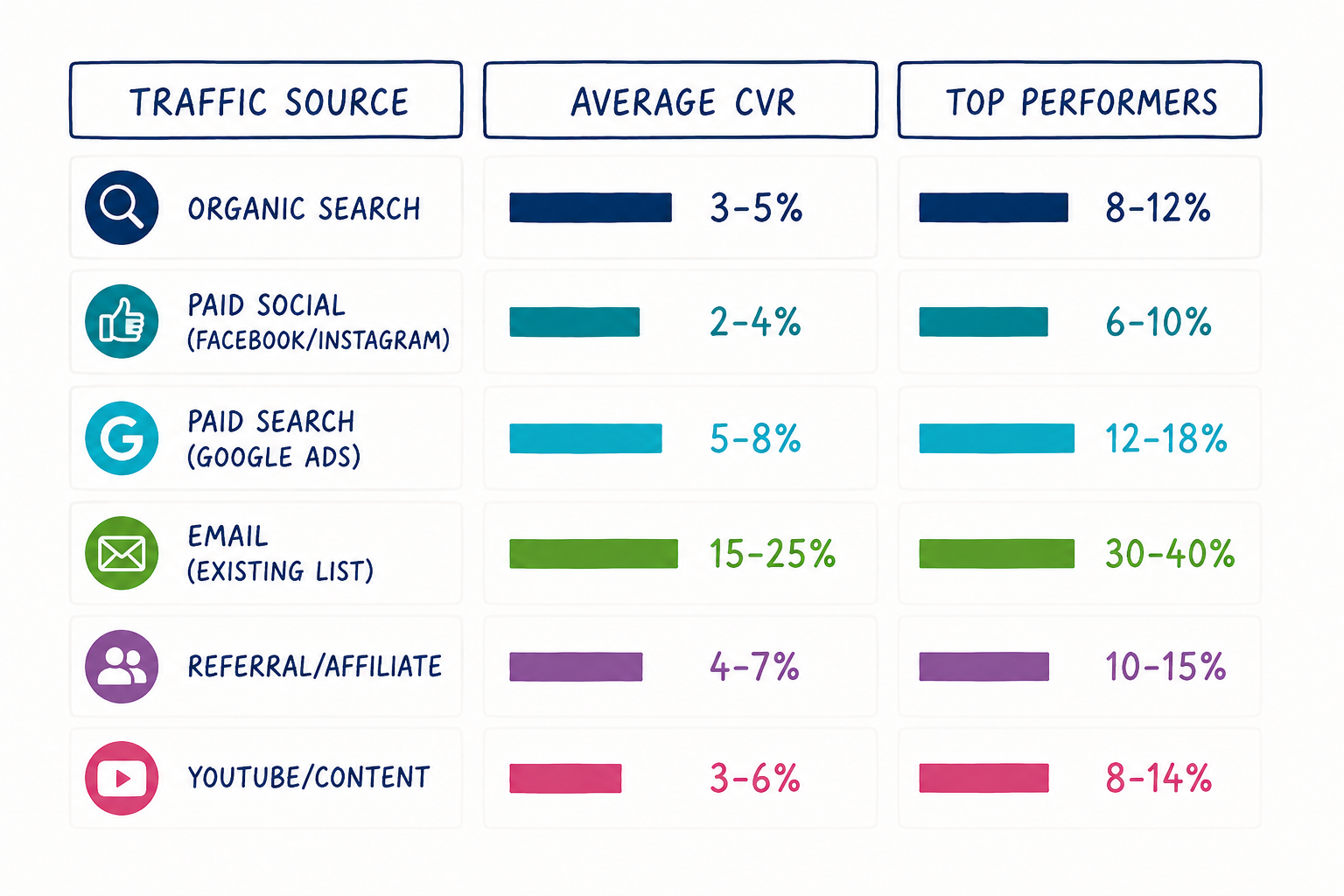
Source: Acceleroi
One thing became clear to me when I was reviewing different online academy websites and enrollment journeys and digging through the data.
The strongest-performing certification providers rarely rely on paid advertising alone.
Books.
Podcasts.
YouTube.
Speaking engagements.
Communities.
Email newsletters.
Graduate referrals.
These often do just as much heavy lifting as paid campaigns.
While research shows that education campaigns on Google Ads generally generate healthy lead conversion rates, those numbers only tell part of the story.
Most students don't discover a founder through one advert and immediately spend several thousand dollars.
They build enrollment confidence over time.
Why it matters
It's easy to look at your advertising performance in isolation.
But enrollment usually happens after multiple interactions.
Someone might:
- hear you on a podcast
- watch a YouTube video
- read a blog article
- join your email list
- attend a webinar
- browse your website
- read your testimonials
...before they finally decide to enroll.
Your enrollment journey almost never starts on the checkout page.
How to Interpret Benchmarks
It's natural to compare your business with others in the industry. That's one of the reasons benchmark reports like this exist.
But the goal isn't to chase someone else's numbers.
It's to build a business that can sustainably deliver the work you believe in.
Some organisations are perfectly healthy at a 1% conversion rate.
Others struggle at 5%.
It depends on your pricing, margins, delivery model, team size, operating costs and long-term vision.
If your business generates enough revenue to continue improving your programs, supporting your students, hiring great people and expanding your impact, that's a far more meaningful measure of success than hitting an arbitrary industry benchmark.
What I love to do with my clients is take their current average conversion rate, make it a baseline and project a few different scenarios for what would happen if the conversion rate rose by 0.1%, 0.3%, 0.5% and so on.
What would that mean in annual revenue? What kinds of business opportunities would that open up? And what would be the first changes I'd recommend in starting to shift the numbers in that direction?
That way we're shifting the actual business reality and competing against the set internal benchmark, not fighting to reach an "industry average", which can lead to some very questionable sales and marketing tactics. And that's just not who my clients are.
Why it matters
Very few people launch a yoga teacher training, coaching school or sound healing program because they're obsessed with conversion rates.
They do it because they want more well-trained practitioners in the world, helping others. And well, there's that part about carrying on the legacy, too, isn't there?
Better enrollment isn't about "winning" at marketing.
It's about creating a sustainable business that allows you to keep doing meaningful work for years to come.
That's why I like to think the numbers tell us what is happening. They don't tell us why.
To understand that, we need to look at how prospective students actually think, what they're worried about, and what ultimately gives them the confidence to enroll in your programs.
03. What Prospective Certification Students Are Really Looking For
To understand your enrollment journey and how well it's serving your students, it's one thing to look at data and statistics. But what we can't forget is to listen to what they're actually saying.
That's often where the biggest insights are.
To understand what people were actually thinking before enrolling, I started reading hundreds of discussions across Reddit, YouTube comments and industry communities.
Not to find out which certification provider people recommended, but to understand what future students were trying to solve. What were they wondering about? What were they afraid of? What was important to them?
Some of the patterns that emerged were remarkably consistent.
Students Aren't Buying a Course
They're choosing a future.
One theme came up over and over again.
People weren't asking:
"Which curriculum is best?"
They were asking questions like: Can I actually make a living doing this? Will people take me seriously? Is this certification respected? Will I feel confident enough to work with clients? Is this worth investing thousands of dollars? Could I hack my way through with free/cheaper education, or do I actually need this?
Very few people seemed worried about whether they could learn the material.
Many were trying to decide whether this could realistically become the next chapter of their lives.
Why it matters
Here's one of the strongest patterns I've observed during this research: the proportion of students willing to invest $1,000 or more purely for their own healing or personal transformation appears to be much smaller than the proportion hoping (at least eventually) to build a practice or make a living using those skills.
This changes the role of your enrollment journey.
You're not simply explaining what's included in your certification and making sure they realize just how comprehensive the syllabus is.
You're helping someone make one of the biggest professional and personal decisions they've made in years.
Confidence Before Commitment
Another pattern became impossible to ignore.
Most certification websites do a reasonable job explaining:
- modules
- schedules
- pricing
- lesson plans
But that's rarely what students were talking about.
Instead, students are looking for confidence.
Confidence that they could do the work.
Confidence that the qualification would be respected.
Confidence that they'd know what to do after graduating.
Confidence that they wouldn't waste their time or money.
I kept coming back to one thought while reading those conversations:
People aren't simply buying education. They're trying to reduce uncertainty.
Interestingly, very few people seemed to be asking for more information. They were asking for different information.
Why it matters
Adding another curriculum module rarely changes someone's decision.
Helping them feel more certain often does.
Sometimes the biggest enrollment barrier isn't missing information.
It's missing confidence.
Career Outcomes & Business Readiness
One thing I found particularly interesting was that purpose and practicality rarely appeared as competing ideas.
Many people described feeling called towards coaching, healing or practitioner work. At the same time, they were asking: Will this be sustainable? Can I earn a living? Will I find clients? Is the market already saturated? Will people pay for this?
That combination feels important.
People aren't looking to choose between purpose and financial stability.
They're looking for both.
Trust Signals That Influence Enrollment
If I had to summarise what I think many future students are really asking, it would be this:
I believe this work is meaningful. Please show me that pursuing it is also a responsible decision.
Why it matters
This is one of the reasons I think more certification providers should talk openly about what happens after graduation.
Not just the certification itself, but the path that follows.
Business skills.
Marketing.
Pricing.
Graduate support.
Mentoring.
Finding your first clients.
Because for many students, those aren't "nice bonuses."
They're what turns an exciting possibility into a realistic future.
You already know how that business works. That's why one of the biggest opportunities I see is helping students build sustainable businesses with their new skills. Not only will you help your students succeed, but you'll also make sure your method reaches even more people.
04. Research Insights for Education Founders
The statistics and research tell us a lot about the industry.
But after reviewing dozens of certification providers and their websites, comparing enrollment journeys and talking with founders, I've also started noticing patterns that don't always show up in benchmark reports.
What the Research Suggests
One of the first things I noticed during my website research was something that seemed almost backwards.
Some of the clearest, most thoughtfully structured enrollment journeys belonged to organisations I'd never heard of.
At the same time, several founder-led brands with confusing navigation, incomplete course information or surprisingly clunky websites appeared to be enrolling students very successfully.
Looking deeper, I realized that many of these organisations weren't relying on their websites to build trust.
They'd already done that through books, podcasts, speaking engagements, interviews, social media or years of teaching.
By the time someone arrived on the website, much of the trust-building had already happened.
Why it matters
A strong founder brand can compensate for a weaker enrollment journey.
But it's a risky strategy.
If the founder steps back, retires or simply wants the business to become less dependent on them, the website suddenly has to carry much more of the trust on its own.
That's when weaknesses often become much more visible.
Common Website Patterns
When people think about improving enrollment, they often imagine a complete website redesign.
In my experience, that's rarely where I'd start.
Sometimes it's making the next step more obvious.
Sometimes it's moving an enrollment button.
Sometimes it's explaining who the program is (and isn't) for.
Sometimes it's simply answering the questions students are already asking elsewhere online.
These are often small changes.
At scale, they can become very valuable.
And this is where the math gets really exciting.
Imagine your certification program website receives 10,000 visitors each month.
Let's say your average program costs $2,000 and course enrollment conversion improves from 1.0% to 1.2%, that's:
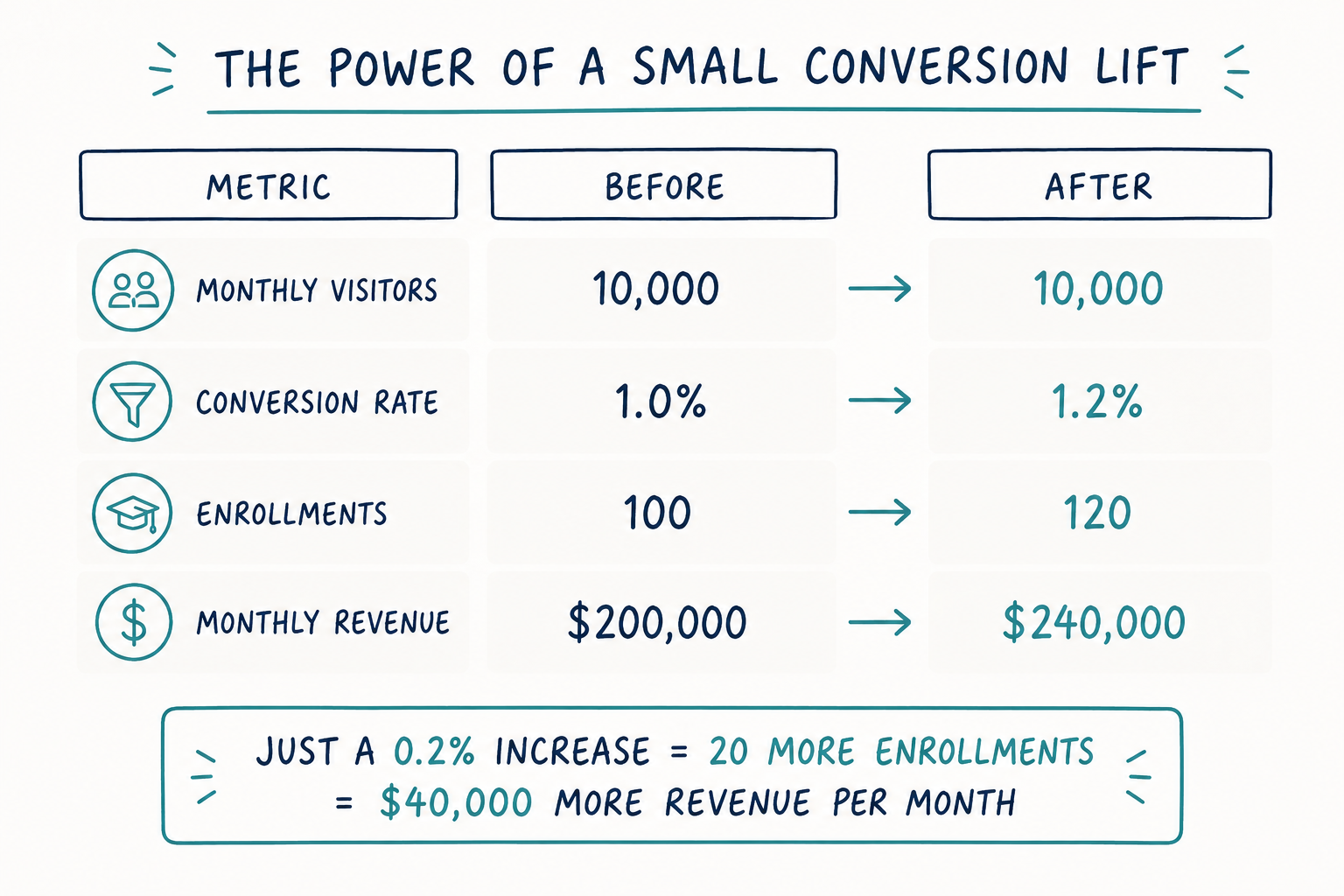
That's an additional $40,000 per month, or approximately $480,000 per year, from things that are often low-hanging fruit changes in the journey.
And notice something else: the traffic didn't change at all.
Why it matters
This isn't really a story about conversion rates.
It's a story about sustainability.
An extra half a million dollars a year could mean:
- hiring another educator
- improving student support
- investing in better learning experiences
- translating programs into new languages
- funding scholarships
- giving the founder room to step back from day-to-day operations
These are the kinds of possibilities I'm always excited to uncover and help make a reality.
Enrollment Friction
This was one of the biggest gaps I noticed.
Most certification providers spend a great deal of time explaining:
- what's included
- how long the program lasts
- how the training is delivered
Far fewer explain what happens after graduation. Can graduates find clients? Is there mentoring?
- Do students receive business training? Is there ongoing support? Can graduates join a directory?
- How have previous students built successful practices?
Yet those were exactly the kinds of questions I kept seeing in student conversations online.
Why it matters
For many of your students, the certification itself isn't the destination.
It's the beginning.
The more clearly you can help someone picture what comes next, the easier it becomes for them to imagine saying yes today.
Many certification websites still forget mobile users
It's an almost ingrained pattern that when we talk about website building or optimization, people still often discuss around a desktop version of the website.
Let's put this button here, let's increase the font there, and so on.
However, according to Similarweb, mobile traffic accounts for around 65% of all web traffic already. The split between mobile and desktop visitors on your website can vary, but in my experience, the stats for online courses and certification programs skew more heavily towards mobile users than desktop users.
A typical picture I see:
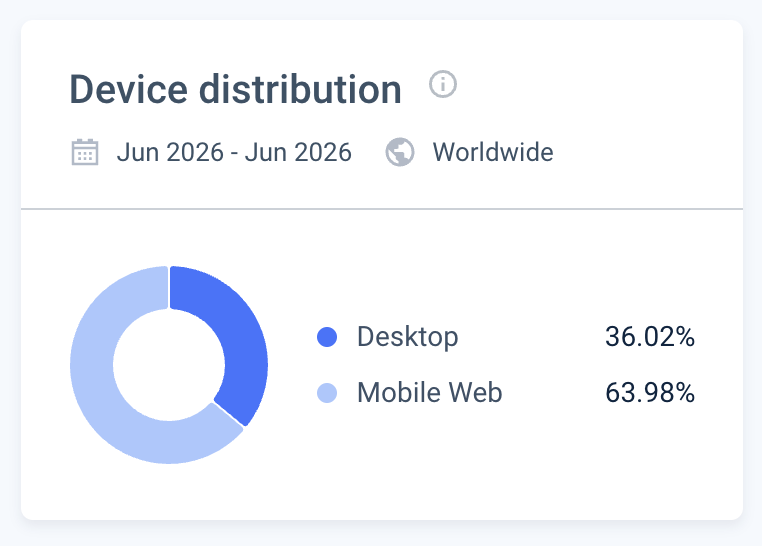
This is an outtake of data from Similarweb on a hypnosis practitioner training program.
This is also supported by research from Unbounce. According to them, visitors in the education industry use mobile devices 6x more than desktop, yet mobile landing pages convert 17.6% worse than desktop landing pages.
Imagine this: someone is skimming your practitioner training website. They've just finished up their day job and are looking for something to lift their spirits. They want to imagine a different kind of lifestyle, working in an industry that's been calling them for a while now.
Imagine they're on a packed train. Or maybe they're sneaking in some of your website scrolling between making dinner and setting the table. Or perhaps they've just gotten the kids to sleep and have 5 minutes before they need to get up and start clearing the mess of the day before turning in.
All of this information seeking is done on a mobile device, in between other things, with a tired brain.
Now open up your own website on your mobile phone and look at it from that person's perspective.
Can they understand what your program offers?
Can they understand the benefits of choosing you over another provider?
Can they start feeling trust towards you from the first moments they enter the site?
Can they find what they're looking for: syllabus, pricing, time commitment, completion requirements, next cohorts, student support and post-graduation help?
If not, you're losing them to your competitors (or to life). They just won't make the leap.
That's why it's crucial not to forget about how your site shows up on mobile devices.
Opportunities for Improvement
One thing became increasingly obvious as I compared websites with Reddit discussions.
Many websites answer questions founders think are important.
Students are often asking different ones.
Founders ask:
Have we explained the curriculum clearly enough?
Students ask:
Will I feel ready to work with real clients?
Founders ask:
Have we listed all the modules?
Students ask:
Will anyone actually pay me for this?
Founders ask:
Have we described our methodology?
Students ask:
Is this the right path for someone like me?
Neither perspective is wrong.
They're simply different.
Why it matters
One of the easiest ways to improve an enrollment journey isn't necessarily by adding more content.
It's answering the questions people are already asking somewhere else.
05. Where the Transformation-Led Education Industry Is Heading
One of the unexpected benefits of reviewing certification websites, reading student conversations and digging through industry reports side by side is that patterns start to emerge.
No single report says these things outright.
They're simply the direction I think the industry is moving in.
Building Trust at Scale
As more certification providers enter the market, and as automated content creation becomes the norm across industries, students will have more choice than ever before, but that choice comes down to the trustworthiness and authenticity of the provider.
When programs begin to look similar on paper, the human touch becomes one of the biggest differentiators.
Not just trust in the founder.
Trust in the organisation, in the graduates, in the outcomes, and in the authenticity of the delivery.
The organisations that consistently show up as human and focus on trust building are the ones I believe will continue to grow.
Graduate Success Beyond Certification
One pattern has stood out repeatedly throughout this research.
Many students aren't simply buying a certification.
They're investing in a future career, a second income or an entirely new identity.
That means expectations are changing.
Business support.
Marketing.
Pricing.
Graduate communities.
Mentoring.
Ongoing education.
I think these will increasingly become part of the enrollment conversation rather than optional extras.
Students don't just want to know how to qualify.
They want to know what happens afterwards.
Founder-Led Brands
Many of today's most successful certification providers were built on the reputation of one extraordinary person.
That's an incredible strength.
It's also one of the biggest strategic questions many organisations will face over the next decade.
How do you preserve everything the founder has built while making sure the organisation can continue to thrive long after they step back?
The strongest organisations will gradually transfer trust from the founder to the organisation itself.
Original research will become a competitive advantage
One thing became very clear while putting this report together.
There are plenty of opinions online.
There are far fewer organizations doing genuine research.
I think that's going to matter more over time.
Founders who understand their students, measure their enrollment journeys and regularly publish original insights won't just improve their own businesses.
They'll become trusted voices in their industries.
Sustainable growth will beat aggressive growth
Perhaps the biggest shift I think we'll start seeing is philosophical rather than technological.
Much of the marketing advice online still focuses on chasing bigger numbers.
More traffic.
More leads.
Higher conversion rates.
But the founders I meet are rarely trying to build businesses for the sake of growth alone.
They're trying to create organizations that can continue teaching, supporting students and expanding their impact for decades.
To me, that's a much healthier definition of success.
One that's built on sustainable enrollment rather than unsustainable growth.
The Future of Student Enrollment
The more time I spend researching this industry, the less I think enrollment is really about websites, marketing funnels or conversion rates.
Those things matter.
But they sit on top of something much deeper.
People enroll when they can picture a believable future for themselves.
Your job isn't simply to explain your program.
It's to help the right people recognise themselves in the future you're inviting them to create.
06. Key Takeaways
If there's one thing I hope you take away from this report, it's this:
Improving enrollment isn't about chasing someone else's conversion rate.
It's about understanding your own students a little better than you did yesterday.
Throughout this report, we've looked at the market, explored enrollment benchmarks, listened to real student conversations and compared dozens of certification providers.
A few themes kept coming back.
The biggest takeaways
- The market for transformation-led education continues to grow, but so does the competition for your students' attention and trust.
- Benchmark your business against yourself first. Industry averages are useful for context, but your most meaningful benchmark is the one you establish inside your own organisation.
- Your students aren't simply choosing a certification. They're deciding whether they can build a meaningful future around the work they feel called to do.
- Confidence matters more than information. Many enrollment barriers aren't caused by missing content, but by unanswered questions about credibility, sustainability and life after graduation.
- Small improvements can have a surprisingly large impact. Sometimes a clearer pathway, better messaging or answering one important question is enough to meaningfully improve enrollment.
- The best enrollment journeys begin long before someone reaches your website. Books, podcasts, videos, recommendations and graduate stories all shape the decision long before someone clicks "Enroll."
- Sustainable enrollment creates sustainable impact. More revenue isn't simply about bigger numbers. It's about creating the freedom to improve your programs, support more students and continue the work you believe in.
One question I'd leave you with
As I was writing this report, one question kept coming back to me.
Not:
How can I improve my conversion rate?
But:
What would need to be true for the right student to feel completely confident saying yes to my program?
I think that's a much more interesting question.
Because the answer probably isn't one big change.
It's dozens of small moments that quietly build confidence throughout the enrollment journey.
What's next?
This report is intended to become a living resource.
As I continue researching certification providers, reviewing enrollment journeys and listening to student conversations, I'll update it with new benchmarks, fresh research and additional insights.
If there's a statistic, benchmark or trend you'd like me to investigate, I'd genuinely love to hear from you.
After all, the best research doesn't end with answers.
It starts better conversations.
Methodology
This report combines published industry research with my customer research across public communities (including Reddit and YouTube), and my original observations from reviewing certification websites, enrollment journeys and consulting work. Published research is referenced. Original observations are clearly presented as observations.
References
1. Global Wellness Institute https://globalwellnessinstitute.org/press-room/statistics-and-facts/
2. McKinsey & Company – Future of Wellness https://www.mckinsey.com/featured-insights/mckinsey-explainers/what-is-the-future-of-wellness
3. Coach Training EDU / Precedence Research https://www.coachtrainingedu.com/nbhwc-certification-program/
4. Grand View Research – Digital Health Coaching https://www.grandviewresearch.com/horizon/statistics/digital-health-coaching-market-outlook/service/health-wellness-coaching/global
5. Grand View Research – Complementary & Alternative Medicine https://www.grandviewresearch.com/industry-analysis/complementary-alternative-medicine-market
6. Grand View Research – Body-Mind-Energy Healing https://www.grandviewresearch.com/industry-analysis/body-mind-energy-healing-market-report
7. Grand View Research – Yoga Market https://www.grandviewresearch.com/industry-analysis/yoga-market-report
8. Coherent Market Insights – Meditation Market https://www.coherentmarketinsights.com/industry-reports/meditation-market
9. Unbounce – Education Conversion Benchmark https://unbounce.com/conversion-benchmark-report/education-conversion-rate/
10. Acceleroi – Higher Education Conversion Rates https://www.acceleroi.com/blog/unlocking-success-exploring-the-average-conversion-rate-for-online-courses