Enrollment journeys
Getting website traffic but not enough enrollments? Here's where I'd look
Even though you might be seeing good website traffic but no conversions, more traffic is often treated as the answer.
More SEO. More ads. More social content. More podcast appearances. More people coming through the door.
And sometimes, yes, you genuinely do need more traffic.
But if your certification or training business is already attracting thousands of website visitors every month and enrollment still isn't where you want it to be, to improve your online course conversion rate, the answer isn't more traffic.
It's: increase course enrollment for those already here.
Therefore, I'd resist throwing more money at traffic until you understand what's happening to the people already arriving.
Because you might not have a traffic problem at all.
You might have an enrollment journey problem.
And those are two very different things.
1. First: do you actually have an enrollment problem?
Before changing your website, increasing ad spend or rewriting your sales pages, get a baseline.
How many people visit your website each month?
How much enrollment revenue do you generate?
What's the average value of an enrollment?
And how do students actually enroll?
That last question matters more than it might seem.
A business selling a $299 course directly from its website has a very different enrollment journey from a school offering a $6,000 practitioner certification that requires an application and admissions call.
Yet we have a habit of throwing all of these businesses into the same conversion-rate bucket.
Research in this area shows us why that's a problem. Published benchmarks vary quite a lot according to program price, audience temperature (how well they know you, how much they trust you and their own motivation) and the point in the enrollment journey being measured. There is also surprisingly little independent, certification-specific conversion research available.
For example, Acceleroi's 2026 online course benchmark data separates sales-page conversion from opt-in conversion and breaks sales conversion down further by program price.
Its higher-education research separates website visitors becoming inquiries from visitors starting applications. In other words, even within education, a "website conversion rate" can mean several very different things.
So don't start with:
"Is my online course conversion rate good?"
Start with:
"What exactly am I measuring?"
Want a quick baseline?
I've built a free Enrollment Health Calculator to help you look at your website traffic, enrollment revenue, program value and enrollment pathway together, then compare your numbers with the closest available industry benchmarks.
2. Where is your website traffic actually coming from?
Ten thousand visitors aren't just ten thousand visitors.
Someone typing your founder's name into Google after listening to three hours of their podcast is in a very different place from someone seeing your business for the first time in a paid Instagram ad.
One knows you, the other doesn't.
One may have spent months thinking about training with you.
The other may still be wondering what you actually do. (Or what they want to do, for that matter, and if your program fits the vision they have for themselves.)
Research into online course enrollment conversion shows it clearly: warm and cold audiences can behave very differently, although the available traffic-source data can't reliably tell us that a particular mix of traffic should result in an exact conversion rate.
Acceleroi's benchmark research, for example, explicitly identifies traffic source alongside price and funnel stage as factors affecting conversion.
That's why I'd want to know your biggest sources of traffic before making judgments about your enrollment performance.
Look at:
- organic search
- direct traffic
- paid search
- paid social
- referrals and affiliates
- social and content
Not because there's one perfect traffic mix.
There isn't.
But because where people come from tells us something about what they might need from the website when they arrive.
If you have no idea where to find this data for your website, the best place would, of course, be to look at your Google Analytics.
However, if to you the Google Analytics dashboard looks like a control room at NASA, or you'd need to ping several people to get access, you can also start on Similarweb. Just input your website link, and look for "Marketing channels" to see where your traffic is coming from.
No time to waste on getting the data you need if you want to improve your enrollment conversion rate and ask better questions from your team, I say.
3. What are you actually asking someone to do?
This is where generic online course conversion rate benchmarks can become particularly unhelpful.
Imagine two businesses.
One asks someone to:
Choose a course → enter their card details → start learning.
The other asks them to:
Consider changing careers → invest several thousand dollars → apply → speak to admissions → decide whether this is the right professional path → enroll.
Those are not remotely equivalent buying decisions.
Published benchmarks for direct-purchase programs also show conversion generally falling as program price rises. Acceleroi's 2026 data puts sales-page-to-purchase conversion for programs between $1,000 and $2,000 at around 0.3 to 1%, while programs over $2,000 sit around 0.1 to 0.5%. These are sales-page conversion benchmarks, rather than whole-website enrollment rates, which is an important distinction.
But if your program requires an application or admissions conversation, the final purchase isn't the only conversion that matters.
You have a chain of decisions.
Website visitor → program page.
Program page → application.
Application → admissions.
Admissions → enrollment.
And suddenly one overall conversion percentage isn't particularly good at telling you where the problem is.
Because you might have a healthy course sales page conversion rate, but your admissions conversion rate might be the one to look at, or vice versa.
That's why conversion rate optimization is truly a multi-faceted exercise, especially for certification programs.
4. Are enough people moving from interest to intent?
This is where I'd start looking more closely at the website.
Not:
"Does the homepage look nice?"
But:
"Are interested people doing anything?"
Are they:
- visiting your program pages?
- clicking through to learn more?
- starting applications?
- submitting inquiries?
- booking admissions calls?
- joining webinars?
- returning to the website?
There's a meaningful difference between people arriving and immediately leaving, and people spending time with your program, reading graduate stories, checking pricing and then disappearing.
Both result in no enrollment.
But they're not the same problem.
This is why conversion rate alone can send you down the wrong rabbit hole.
You want to understand how far people are getting.
If you have no idea where to even start looking for that information, you can once again check out Similarweb. Enter your website and look for Pages / Visit. This tells you how many pages the average visitor looks at during a visit. Then compare it to your closest competitors.
It's a very rough measure, but it can give you a quick sense of whether people are exploring your site or barely getting past the page they landed on. Similarweb recommends using Pages / Visit alongside other engagement metrics rather than treating it as a standalone measure.
That's because two people with very different experiences can give similar pages/visit data. One is seriously interested in your certification enrollment and is mentally collecting the evidence this is the right choice by reading testimonials, FAQs, the founder story, program syllabus, etc. The other one is clicking around frantically, trying to find the price.
5. If people are showing intent, where are they disappearing?
This becomes particularly interesting for higher-ticket certification programs.
Let's say you're getting plenty of applications.
Great.
How many turn into admissions conversations?
And how many of those conversations turn into enrollments?
Again, I'd be careful about grabbing an arbitrary percentage from the internet and declaring your admissions process healthy or unhealthy.
The more useful question is what happens between each meaningful step in your own enrollment journey.
If traffic is healthy, people are reaching your program pages and applications are coming in, but very few applicants enroll, getting another 5,000 people onto the website may not be the first problem I'd solve.
Equally, if hardly anyone ever gets as far as applying, blaming admissions doesn't make much sense either.
Follow the journey.
6. Does your website answer the questions that actually determine the decision?
This is the part I find particularly interesting.
When I researched how future students actually talk about certification programs (Reddit, LinkedIn, Quora and others), the questions weren't confined to:
How many modules are there?
How many training hours do I get?
Is there a downloadable workbook?
They were asking much bigger questions.
Can I actually make a living doing this?
Will people take me seriously?
Is this certification respected?
Will I feel confident enough to work with clients?
What happens after I graduate?
Is spending thousands on this a responsible decision?
And yet so many certification websites devote enormous amounts of space to explaining the syllabus while giving remarkably little space to the future the student is trying to create.
Module 1.
Module 2.
Module 3.
Is the syllabus important? Of course!
But put into context, the person reading it is trying to work out whether this could become the next chapter of their life, so there might be far more important questions to answer.
That's an enrollment problem you won't necessarily find in Google Analytics.
The data might tell you where people stop.
Understanding your students helps you work out why.
7. Only then would I ask whether you need more traffic
There comes a point where the answer genuinely is:
We need more of the right people finding us.
Good.
Invest in SEO.
Run the campaigns.
Build partnerships.
Get the founder onto podcasts.
Create the YouTube channel.
But I'd want to know that the enrollment journey underneath all of that is doing its job first.
Because sending more people into a journey that isn't helping them confidently move forward doesn't solve much.
It just gives the problem a bigger audience.
And for an established education business, relatively small improvements can matter.
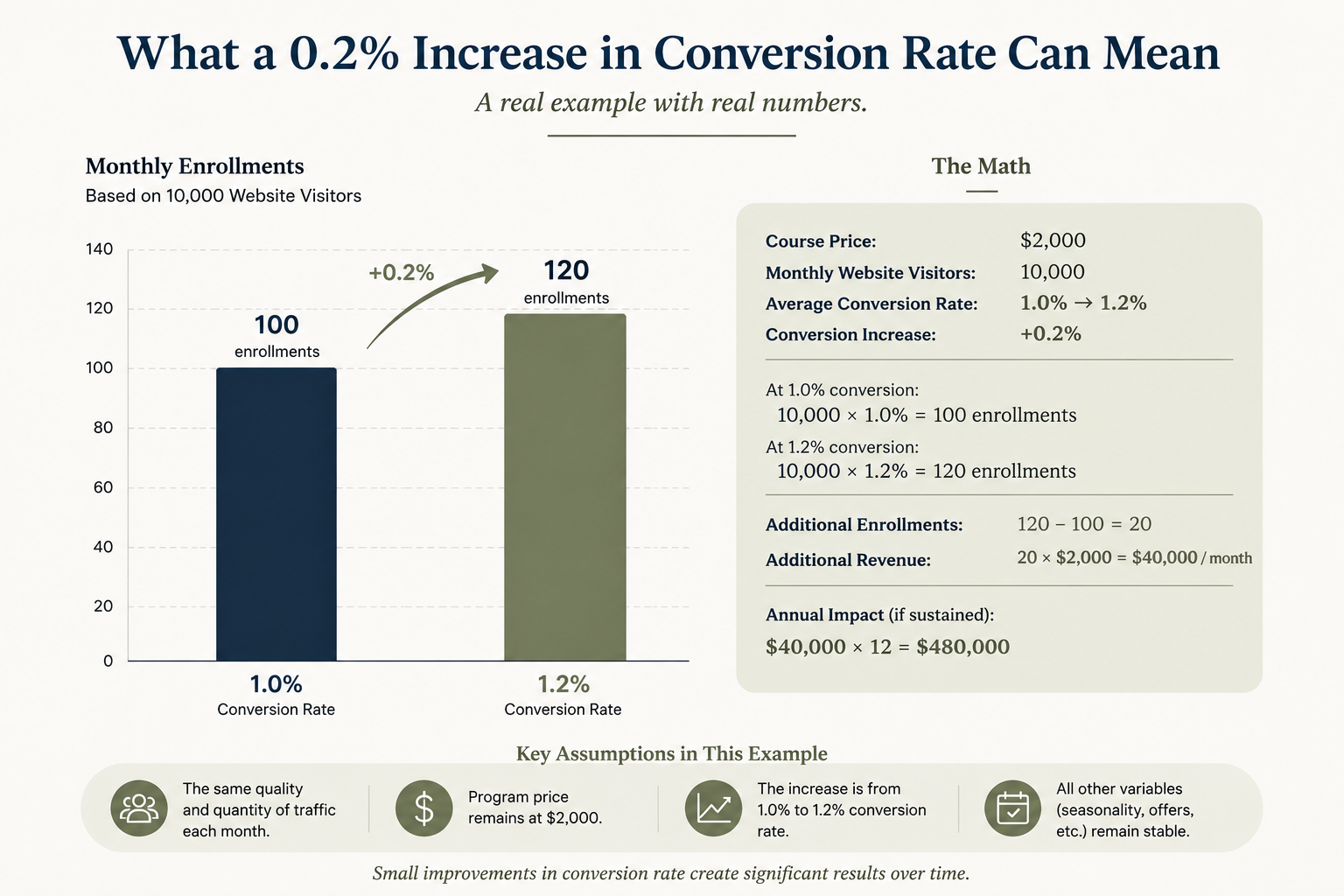
If 10,000 people visit your website every month and 1% eventually become students, that's 100 enrollments.
Move that to 1.2%, and it's 120.
Same traffic.
Twenty additional students.
At a $2,000 average enrollment value, that's a difference of $40,000 in monthly enrollment revenue, or $480,000 across a year if that performance were sustained.
That's not a promise that changing a headline will magically produce another $480,000.
It's simply a reminder that once a business has meaningful traffic and meaningful program value, small leaks (and small improvements) can become commercially significant.
What would an extra 0.2% increase in your conversions mean for your business?
What could you do that you can't do today?
If you want to know exactly how much that is, check out the enrollment conversion rate calculator.
You may not need more traffic. You may need a better enrollment journey.
When enrollment slows, traffic is one of the easiest numbers to blame because it's visible.
But traffic is only the beginning of the journey.
I'd want to know:
Who is arriving?
What are you asking them to do?
Are they moving from interest to intent?
Where are they stopping?
And does the experience give them enough confidence to make what may be a very significant decision?
Only then can we tell whether you need more people coming through the door, or whether the bigger opportunity is what happens once they're already inside.
Want to look closer?
If you're getting traffic but aren't sure where the enrollment opportunity is, let me have a look at your enrollment journey and data over a free discovery call.
Key Takeaways
- More website traffic won't necessarily increase online course enrollment if the bigger problem sits inside your enrollment journey.
- Your online course conversion rate needs context. Program price, traffic source and whether students buy directly, apply or speak to admissions all affect what a healthy conversion rate might look like.
- Don't rely on one overall website conversion rate. Look at how prospective students move from interest to intent, including program-page visits, inquiries, applications and admissions calls.
- If people are already showing intent but aren't enrolling, find out where they're dropping out before spending more money on traffic.
- Improving your course conversion rate doesn't always require a dramatic change. For an established business with meaningful traffic, even a small improvement can have a significant effect on enrollment revenue.
- The goal isn't simply to increase online course enrollment. It's to understand whether your existing enrollment journey is helping enough of the right students confidently move forward.
About the author

Hanna-Mari Kirs
Founder & Strategist, Heroes & Guides
Hanna-Mari is an enrollment strategist researching how online educators, certification providers and course creators can improve student enrollment conversion through clearer enrollment journeys, decision-making psychology and website strategy.