Enrollment strategy
Online course conversion rate: what actually drives enrollment?
If your online course conversion rate isn't where you'd like it to be, there are approximately 4,736 things you could change.
Rewrite the sales page.
Run more ads.
Change the pricing.
Add testimonials.
Shorten the application.
Build another funnel.
Move the button.
Make the button orange.
Please don't start with the button.
Because before you start optimizing anything, you need to understand what is actually driving your conversion rate in the first place.
For established online courses and certification programs, I tend to look at three things:
Who arrives.
What they experience.
What they understand and believe.
Together, those three things influence the number we're actually interested in:
Who enrolls.
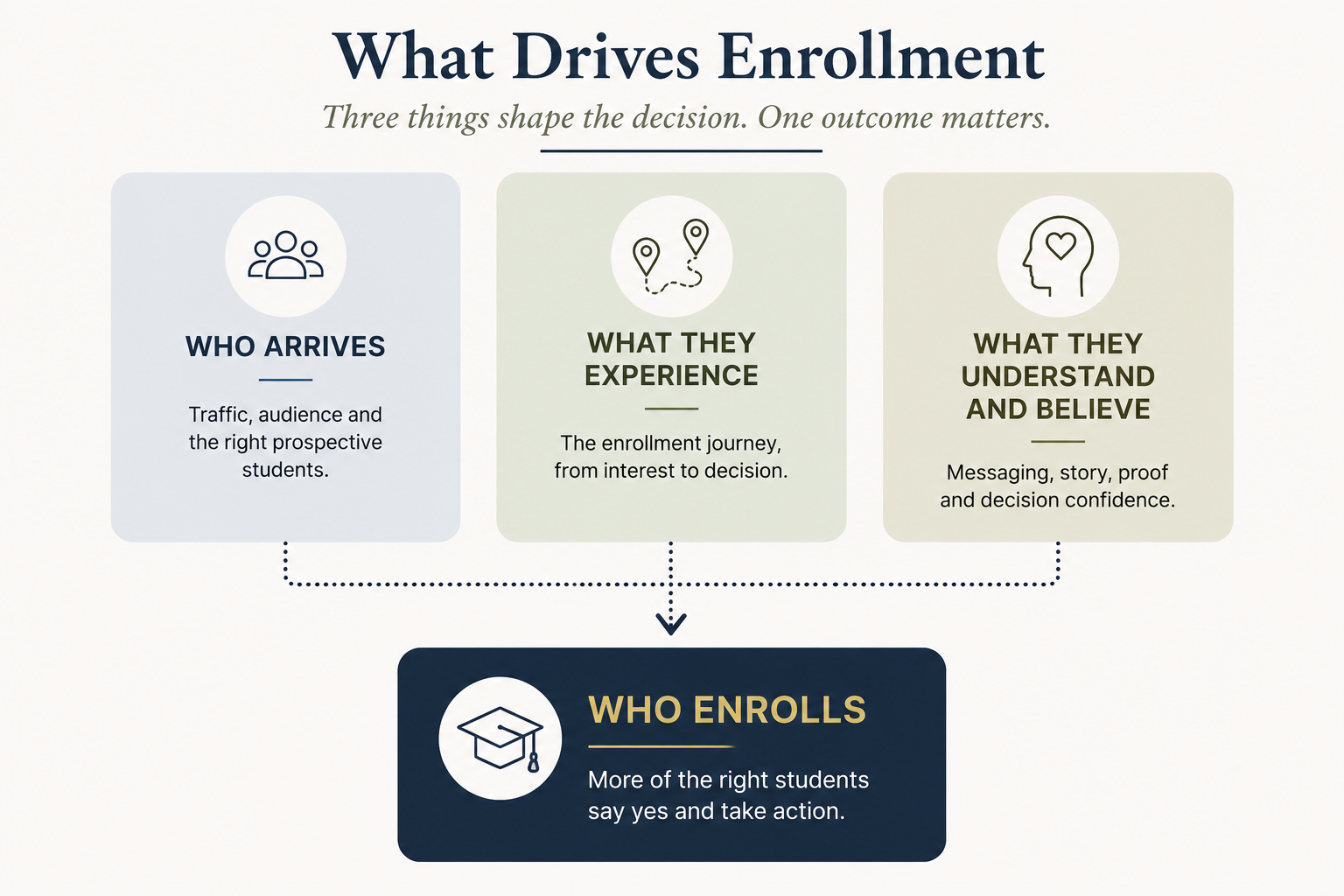
And if you can figure out which part isn't doing enough of the heavy lifting, conversion optimization becomes a much more useful exercise than randomly changing things on your website and hoping enrollment goes up.
Key Takeaways
-
Your online course conversion rate tells you what percentage of visitors enroll. It doesn't tell you why they do or don't.
-
Average course conversion rates vary significantly according to program price, traffic source and enrollment pathway.
-
Before trying to increase course enrollment, look at three things: traffic and audience, the enrollment journey, and messaging and decision confidence.
-
More website traffic won't necessarily improve enrollment if the wrong prospective students are arriving.
-
A smooth enrollment journey still won't convert if students don't understand the value of the program or feel confident enough to choose it.
-
Good conversion rate optimization starts with diagnosis, not a list of CRO tactics.
Want to know how your course conversion rate compares?
My free Course & Enrollment Conversion Rate Calculator uses your website traffic, program revenue, average program value and enrollment pathway to give you a quick benchmark against the closest available industry data.
What is an online course conversion rate?
At its simplest, your online course conversion rate measures the percentage of people who take the action you're measuring.
And that last bit matters.
Because when people talk about a "course conversion rate," they aren't always talking about the same thing.
One benchmark might measure:
Sales page visitor → purchase
Another might measure:
Website visitor → enrollment
Another:
Lead → enrollment
Or:
Application → enrollment
That's one reason published average online course conversion rate research can be frustratingly difficult to do.
In the Enrollment Health Calculator I created, you can switch between sitewide enrollment conversion rate and sales page enrollment conversion rate:
The former gives founders a relatively easy number to find without needing to excavate six analytics dashboards first.
But if you have more detailed data, you can go much further.
An application-led certification program, for example, might look at:
Website visitor → application → admissions call → enrollment
That tells you much more about where prospective students are dropping out.
What's a good conversion rate for an online course?
This is where I'd love to give you one lovely percentage and send you on your way.
"The conversion rate for online courses should be X and here's what you need to do to get yours there."
Unfortunately, that would be misleading.
Published benchmarks vary a lot depending on what is being sold, how much it costs, where the audience came from and what the researcher actually counted as a "conversion."
The available course conversion research I've reviewed suggests that price alone can make a considerable difference. Lower-priced offers tend to have higher conversion benchmarks, while programs costing several thousand dollars typically convert at lower percentages.
That makes sense.
Buying a $99 course can be an impulse decision.
Enrolling in a $4,000 professional certification is a different beast entirely.
You may be committing months of your life, changing career direction and spending enough money that the decision is no longer purely a "me decision."
It's a household-finances decision.
And if the program requires an application, admissions interview or sales call, comparing its sitewide conversion rate with a low-cost course that can be purchased in three clicks isn't particularly useful either.
I've pulled the available benchmarks and their sources together in my Online Certification & Training Statistics 2026 report, including conversion data by price point and traffic source.
And if you want to apply those benchmarks to your own business, the Course & Enrollment Conversion Rate Calculator lets you enter your website traffic, program revenue, average program value and enrollment pathway to get a quick benchmark.
But here's the important part:
Knowing whether your conversion rate looks high, low or somewhere in the middle still doesn't tell you what to fix.
For that, we need to look underneath the number.
1. Traffic and audience: Who is actually arriving?
The first conversion question isn't:
How do we get more website traffic?
It's:
Are enough of the right prospective students arriving?
Those are not the same problem.
Imagine two certification businesses both receive 10,000 website visitors a month.
One gets most of its traffic from an established founder's podcast, branded Google searches, graduate referrals and an engaged email list.
The other gets most of its visitors from cold paid-social campaigns.
Their traffic numbers look identical.
Their visitors don't.
One audience may already know the methodology, trust the founder and arrive actively considering certification.
The other may have discovered the company 30 seconds ago.
Available online-course benchmarks show big differences in conversion rates between traffic sources. For example, Acceleroi reports higher landing-page conversion benchmarks for existing email audiences than for paid social traffic.
However, the available research isn't reliably segmented enough for me to say that a particular traffic mix should produce an exact course conversion rate.
That's why I care about traffic quality and audience intent, not simply visitor numbers.
If your course enrollment is underperforming, ask:
-
Where are prospective students coming from?
-
Which sources send people who actually engage with the site?
-
Are people searching specifically for you, or discovering you for the first time?
-
Are your highest-volume sources producing inquiries, applications or enrollments?
-
Are you attracting prospective students in the first place?
If you're already getting meaningful website traffic but not enough students are enrolling, don't automatically buy more traffic.
You may simply be pouring more people into a journey that isn't doing its job.
2. Enrollment journey: What happens when they get there?
Now we move from who arrives to what they experience.
This is where conventional conversion rate optimization often starts talking about landing pages, CTA placement, form length, navigation and checkout friction.
Those things matter.
But certification enrollment journeys are often considerably bigger than one landing page.
A prospective student might:
discover you through Google
read about your methodology
compare several certifications
look at practitioner outcomes
check accreditation
read your founder story
watch a webinar
join your email list
return to the website three weeks later
look at pricing
talk to their partner
submit an application
speak to admissions
and finally enroll.
That's a very different conversion journey from:
Landing page → Add to cart → Checkout.
So when I look at an enrollment journey, I'm asking:
Can someone who is genuinely interested work out where to go and confidently keep moving?
That means looking at things like program discovery, navigation, calls to action, application processes, admissions handoffs and what happens between moments of high intent.
For a direct-purchase course, the journey may be relatively short.
For an application-led certification, there are more opportunities for prospective students to disappear.
That's why the enrollment pathway matters when interpreting your conversion rate.
If you have the data, don't just look at:
Visitors → enrollments
Look at:
Visitors → inquiries
Visitors → applications
Applications → admissions
Admissions → enrollments
Suddenly, "our conversion rate is low" becomes something much more useful:
We're getting applications. We're losing people afterwards.
Now we have somewhere to look.
3. Messaging and decision confidence: What do they understand and believe?
Here's the part of conversion optimization I think gets underestimated.
Someone can arrive on exactly the right page.
The page can load beautifully.
The navigation can make perfect sense.
The application can work flawlessly.
And they can still leave.
Because usability isn't the same thing as decision confidence.
Your prospective student is trying to answer much bigger questions:
Is this right for me?
Why this certification?
Why should I trust these people?
What will I actually be able to do when I finish?
Will this qualification mean something?
Could I build a career with it?
Have people like me succeeded?
Is it worth the investment?
Can I actually do this?
And, once your program reaches a certain price:
How do I explain this decision to my partner?
That last question gets overlooked constantly.
If someone needs to go home and say:
"I want to spend $5,000 on this certification."
your website has another audience you may never meet.
Their partner isn't sitting through your webinar.
They probably haven't listened to your podcast.
They don't know why your methodology is different.
Your prospective student needs enough clarity to explain the decision themselves.
Give them the language.
This is where brand narrative, positioning and messaging become part of conversion optimization.
Not because every certification website needs a more poetic founder story.
Because people can't confidently choose something they don't clearly understand.
And for a high-consideration certification, you're rarely selling curriculum alone.
You're selling the possibility of what that curriculum allows someone to become.
So which part of your course conversion rate needs optimizing?
This is where I'd resist jumping straight into tactics.
Start with the evidence you actually have.
If you have plenty of traffic but very little meaningful engagement, look at who is arriving and whether what they find immediately matches what they expected.
If people explore your programs but very few inquire or apply, look harder at the enrollment journey and messaging.
If applications are healthy but admissions calls aren't happening, investigate what happens between those two moments.
If people reach admissions but don't enroll, look at qualification, expectations, objections, value, trust and decision confidence.
If conversion is healthy but enrollment numbers are still too low to support the business, then you may genuinely have a traffic problem.
This is why I don't think conversion optimization should begin with:
What should we change?
It should begin with:
Where are we losing the right people?
Those lead to very different projects.
Don't optimize the website. Optimize the enrollment decision.
Your website matters enormously.
But the website isn't the thing making the decision.
A person is.
That's why I think about course conversion optimization through these three lenses:
Traffic & audience Are the right people arriving?
Enrollment journey Can they confidently move forward?
Messaging & decision confidence Do they understand and believe enough to say yes?
All three influence:
Who enrolls.
And that's ultimately the point.
Not a prettier sales page.
Not a higher arbitrary percentage in Google Analytics.
More of the right prospective students making a confident decision to join your program.
Want to know how your enrollment numbers compare?
Use the Course & Enrollment Conversion Rate Calculator to calculate your current enrollment conversion rate and compare it with the closest available benchmarks for your program price and enrollment pathway.
Want to look closer?
If the numbers suggest there's more opportunity hiding in your existing traffic, let me have a look at your enrollment journey and data over a free discovery call.
About the author

Hanna-Mari Kirs
Founder & Strategist, Heroes & Guides
Hanna-Mari is an enrollment strategist researching how online educators, certification providers and course creators can improve student enrollment conversion through clearer enrollment journeys, decision-making psychology and website strategy.