Founder-led brands
Your reputation is carrying your website. But for how long?
Founder-led certification programs often succeed despite messy websites. Here's why, and how a better enrollment journey can unlock more enrollments.
I've been reviewing dozens of online course websites and certification landing pages for clients and for research. There's a pattern I've noticed that didn't quite make sense until I dug deeper.
In my research, I noticed something that didn't quite add up. Some of the clearest, most thoughtfully structured enrollment journeys belonged to organisations that seemed to attract relatively modest engagement. At the same time, a handful of websites that felt cluttered, confusing or surprisingly difficult to navigate appeared to be performing remarkably well.
At first, I assumed I was missing something.
Then I started paying less attention to the websites themselves and more attention to the people behind them.
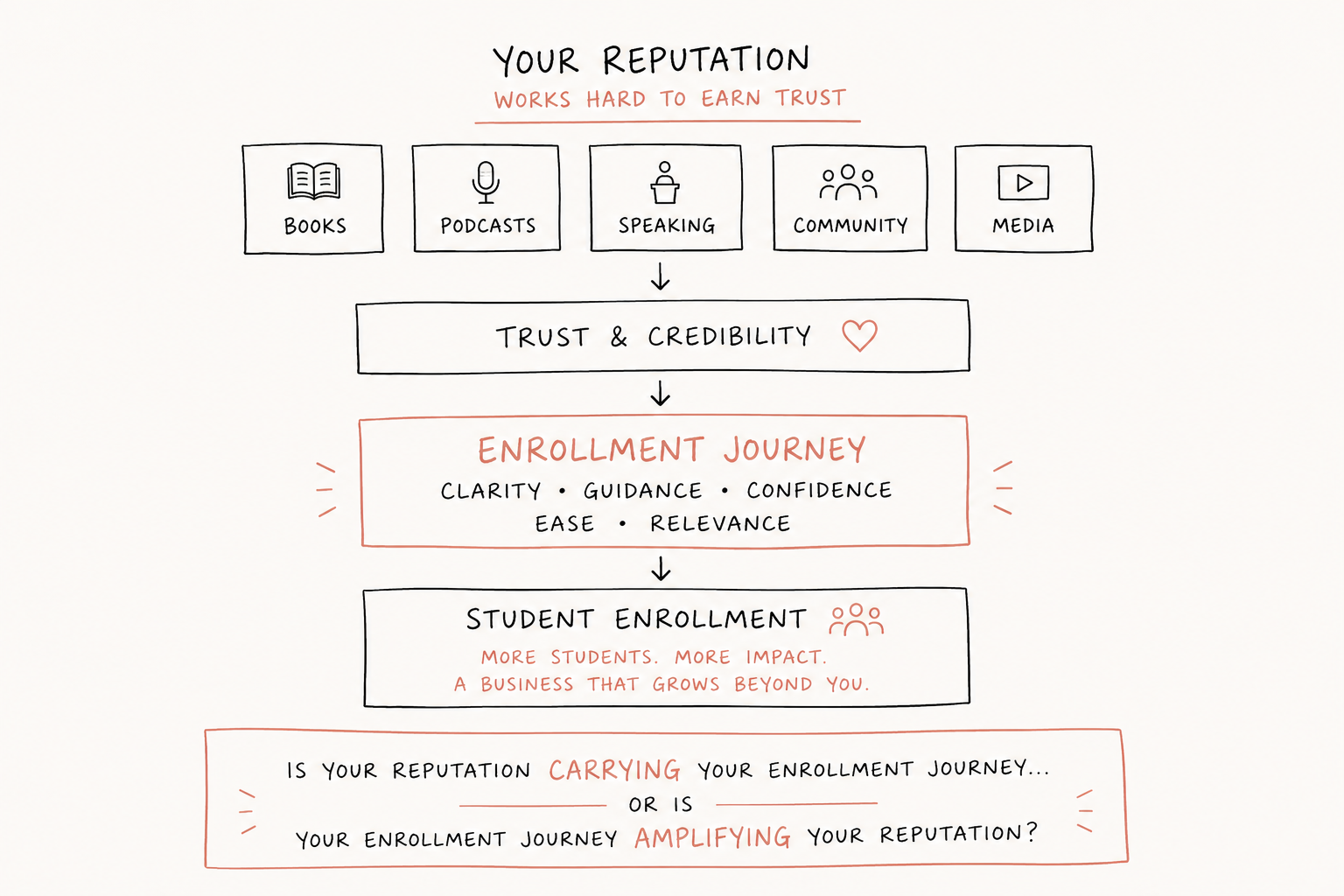
Books.
Podcasts.
TED talks.
Interviews.
Years of teaching and thought leadership.
Entire communities built around a single methodology.
A pattern began to emerge.
Many of the certification providers with the strongest engagement also had something else in common.
They weren't just organisations.
They were founder-led brands.
Founder-led brands are businesses where the founder's personal brand and influence significantly contribute to the organization's identity and customer trust.
Your personal brand changes the rules.
When somebody lands on the website of a founder they've admired for years, they're not arriving as a cold visitor.
They've often read the book.
Listened to the podcast.
Watched the keynote.
Seen clips shared by colleagues.
Followed them on social media.
Long before they reach the homepage, they've already answered one of the biggest questions every student enrollment journey has to solve:
Can I trust these people?
That's not a small thing.
Edelman calls this the collapse of the purchase funnel, arguing that consumers build relationships with brands across podcasts, social media, communities and other touchpoints long before making a purchase.
Trust is arguably the hardest part of any high-ticket purchase. A $2,000 certification isn't an impulse buy. It's a decision about your future, your career and, often, your identity.
Founder-led brands have already done a remarkable amount of that work before the website even enters the picture.
Trust refers to the confidence and belief customers have in a brand's reliability and integrity, especially crucial for high-ticket purchases.
Which also explains something else I noticed.
Visitors seem willing to forgive far more friction than they would on an unfamiliar website.
They'll hunt for information.
Compare pages.
Revisit the site several times.
Dig through FAQs.
Even tolerate confusing navigation.
Not because the experience is good, but because they're so motivated by the transformation that they're willing to work harder to get there, website usability be damned.
That motivation is powerful. But it shouldn't be the thing your student enrollment depends on.
That's both a strength and a trap.
The more I thought about it, the more I realised that founder trust and authority can become a little deceptive.
It can easily mask enrollment friction.
A founder's reputation can carry a surprisingly confusing website.
But carrying isn't the same as supporting.
Imagine spending fifteen years writing books, speaking on stages, appearing on podcasts and building a loyal community around your work. Then launching a certification programme that reflects everything you've built.
Your reputation has become an extraordinary business asset.
The question is:
Is your website an equal asset to you, helping your reputation do its job, or quietly asking it to work even harder?
Those are two very different things.
Enrollment friction is the resistance potential customers experience during the signup or registration process, often due to complexities or obstacles on a website.
The maths becomes surprisingly interesting.
Let's imagine an online education or certification programme that charges $2,000 per student.
The website attracts 10,000 visitors each month.
If just 1% of those visitors enroll, that's 100 students every month, or roughly $2.4 million in annual revenue.
Now imagine improving the enrollment journey just enough to move enrollment from 1.0% to 1.2%.
Not two percentage points.
Just two-tenths of one.
That small increase represents just twenty additional students every month.
That's an extra $480,000 in annual revenue.
Increase enrollment to 1.5%, and you're looking at $1.2 million in additional annual revenue, without attracting a single extra visitor.
That's why I find enrollment conversion optimization so fascinating.
People often assume conversion optimization means redesigning the entire website.
In reality, it can be much smaller than that.
A clearer starting point.
A stronger headline.
A more obvious next step.
Moving a call to action to where people naturally expect to find it.
Answering a question before somebody has to go looking for it.
Small changes.
Large numbers.
Enrollment conversion optimization refers to the strategic process of using enrollment psychology and website conversion best practices to enhance a website's ability to convert visitors into paying students through targeted improvements.
John Warrillow makes a similar argument in Built to Sell. Businesses become significantly more valuable when they can thrive independently of their founders, rather than relying on them to generate every sale or maintain every customer relationship. While Warrillow writes primarily about business valuation, I couldn't help wondering whether the same principle applies to student enrollment.
One day, every founder steps back.
Most founders don't build a business because they want to spend the next thirty years answering the same questions, appearing on every webinar or carrying every enrollment themselves.
Eventually, they want to step back.
Sometimes gradually.
Sometimes unexpectedly.
I've seen this with my clients. The organizations that thrive beyond that moment have usually done something very well.
They've found ways to transfer trust from the founder to the business.
That's where your enrollment journey becomes far more than a marketing asset.
It becomes part of the legacy you're building.
Because if prospective students can only find their confidence through you personally, then your reputation is doing all the heavy lifting.
Your website should be helping.
The opportunity isn't to replace the founder.
One of the things I admire most about founder-led businesses is that they're built on years, sometimes decades, of trust.
That's incredibly difficult to create.
The goal isn't to replace that trust with clever marketing.
It's to honour it.
To build an enrollment journey that makes it easier for future students to act on the confidence your reputation has already created.
Your personal brand has already opened the door.
Your website should make it effortless to walk through it.
An enrollment journey is the path a potential student takes from initial interest to final registration, ideally designed to facilitate a smooth and confident decision-making process.
A simple exercise
Open your homepage.
Now imagine you've announced that you're taking a year away from the business.
Would your website still inspire the same confidence?
Would it answer the same questions?
Would it make prospective students feel just as certain about taking the next step?
Or is your reputation quietly carrying more of your enrollment journey than you realised?
Key Takeaways
Your reputation is carrying your website.
-
A strong personal brand can compensate for a surprising amount of enrollment friction. When prospective students already trust the founder, they're often willing to work much harder to find the information they need.
-
Trust changes how people experience your website. Visitors who arrive through your books, podcasts, talks or community aren't evaluating your organisation from scratch. They're arriving with confidence you've already earned.
-
That's both a competitive advantage and a hidden risk. A founder's reputation can quietly mask weaknesses in the enrollment journey, making it difficult to see where future students are struggling.
-
Most founders eventually want their business to thrive without relying on them every day. That transition becomes much easier when trust is transferred from the founder to the organisation through a clear, confidence-building enrollment journey.
-
Improving student enrollment doesn't always require a complete website redesign. Sometimes a clearer pathway, stronger messaging or better information sequencing is enough to unlock meaningful growth.
-
Small improvements in enrollment conversion create outsized financial returns. For high-ticket certification programmes, even a 0.2% increase in enrollment can translate into hundreds of thousands of dollars in additional annual revenue.
-
Your enrollment journey should amplify the trust you've already built. It shouldn't rely on your reputation to compensate for unnecessary friction.
-
The real question isn't whether your personal brand is strong enough. It's whether your website would continue building confidence if you stepped back from the business tomorrow.
About the author

Hanna-Mari Kirs
Founder & Strategist, Heroes & Guides
Hanna-Mari is an enrollment strategist researching how online educators, certification providers and course creators can improve student enrollment conversion through clearer enrollment journeys, decision-making psychology and website strategy.