Enrollment strategy
Your certification program enrollments are down. What should you fix first?
Enrollment is down. Your latest cohort course conversion rate was worse than the last which was worse than the one before.
You're in a meeting titled: How to increase enrollment.
Everyone has a theory.
Marketing thinks you need more traffic.
Admissions thinks the leads aren't good enough.
The founder thinks the price is too high.
Someone suggests rebuilding the website.
Someone else thinks you need a better webinar.
And before long, you're changing six things at once without actually knowing whether any of them caused the problem.
This is where I'd stop.
Because changing something isn't the same thing as diagnosing something.
If your certification program enrollment has dropped, the first job isn't to decide what needs fixing.
It's to figure out what actually changed to lead to your course sales declining.
Key Takeaways
-
When certification enrollments are down, start with current and historical data rather than assumptions about what led to leads not converting.
-
More traffic won't necessarily fix low enrollment if prospective students are already getting lost further down the journey.
-
I look at six stages: Attract, Engage, Evaluate, Commit, Qualify and Enroll.
-
Don't only look at the website. Changes to admissions, applications, payment plans and internal processes can create enrollment friction too.
-
Losing people during an enrollment journey isn't automatically a problem. The goal is to understand whether the process is appropriately filtering people or unnecessarily losing the right ones.
-
A change in one metric gives you somewhere to investigate. It doesn't automatically tell you why the change happened.
-
The goal of a good conversion audit isn't to manufacture problems. It's to understand what's real, measurable and actionable. Then answering the question: how to increase course enrollment becomes a fact-based game of logic.
Not sure whether your enrollment numbers are healthy?
My free Enrollment Health Calculator gives you a quick benchmark using your website traffic, enrollment revenue, average program value and enrollment pathway.
Before you try to increase enrollment, find out what changed
If enrollments are down this quarter, I don't want to start by asking:
What's wrong with the website?
I want to know what the enrollment journey looked like before and what it looks like now.
That means current and historical data.
How many people were arriving?
How many engaged?
How many seriously considered the program?
How many committed to the next step?
How many qualified?
How many eventually enrolled?
Because the final enrollment number is the outcome of everything that happened before it.
If you only look at the last number, you're trying to diagnose the entire system from one symptom.
The six stages I look at in a certification enrollment journey
When I'm answering the question: "How to increase course sales?" for a client, I start by breaking the enrollment funnel into six stages:
1. Attract
Who is arriving?
How many people are visiting the website?
Where are they coming from?
Has total traffic changed?
Has the traffic mix changed?
Are more visitors coming through organic search, direct traffic, email, referrals or paid campaigns?
And, where the data is available, who are those people?
This matters because a fall in enrollment caused by falling qualified traffic is a very different problem from stable traffic that simply isn't progressing.
But this is also where businesses can make one of the quickest wrong diagnoses.
"We need more traffic."
Maybe.
But if traffic is healthy, getting more people through the door may just give your downstream friction a larger audience.
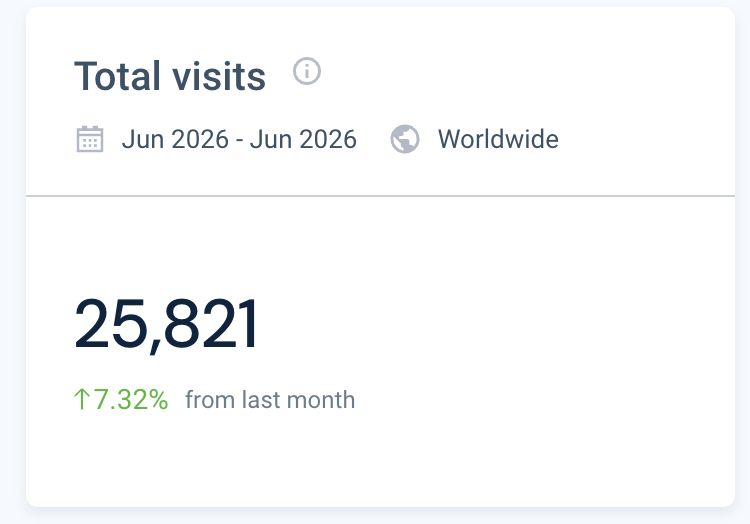
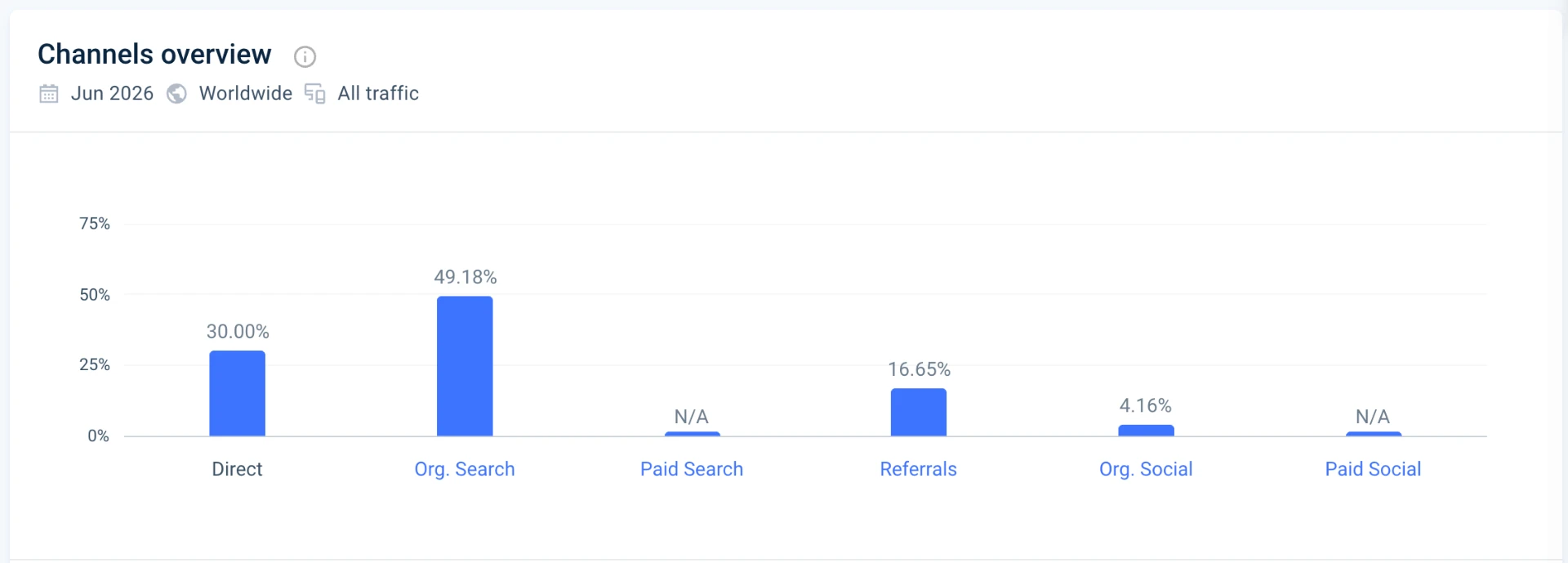
Like this established certification program. They have a healthy amount of traffic that has increased 7% compared to last month. Note especially the direct and referral traffic (AI search is also in this category). These are visitors arriving already at least somewhat aware of what they do and who they are.
The organic search here means that people are searching for programs in the industry and arriving on the site through search engines.
The non-existent paid traffic tells me that there are no (or a very small percentage) visitors coming in cold.
So, with this program, traffic would definitely not be at the forefront if I started to investigate their enrollment conversion issues. Instead, I'd look downstream in the enrollment funnel.
This data is based on Similarweb's reporting and is directional because they don't have access to the company's actual analytics. But since I have also seen this company's Google Analytics dashboard, I can say it's pretty accurate.
2. Engage
Are the right people recognising that this training could be relevant to them?
This stage is harder to reduce to one perfect metric.
You might look at:
- program-page visits
- pages per visit
- key CTA clicks
- return visits
- time spent on important pages
- video or webinar interactions
- email signups
- resource downloads
But engagement isn't simply:
"Did they buy?"
Most website visitors aren't ready to enroll the first time they meet you.
Some are researching.
Some are comparing programs.
Some are wondering whether this career is even right for them.
Some may be six months away from making a decision.
That doesn't automatically make them "lost traffic."
The more useful questions are:
Are the right people arriving?
Are they recognising what they should do to enter your ecosystem, even if they're not ready to enroll?
Is your website experience giving them the next logical step, wherever they are in their journey?
Maybe that's downloading a brochure.
Joining the email list.
Attending an information session.
Reading graduate stories.
Saving the program.
Returning later.
The website's job isn't always to convert the visitor into a student immediately.
Sometimes it's to make sure that when they are ready, you're already part of the decision, mentally or physically through email, content or another point of connection.
3. Evaluate
How are prospective students seriously considering whether the program is right for them?
This is where general interest starts becoming more deliberate.
What does evaluation look like in your business?
Downloading the syllabus?
Requesting a brochure?
Attending an information session?
Joining a webinar?
Looking through graduate outcomes?
Reading the pricing page?
Starting an application?
That last one is particularly interesting.
Because starting an application doesn't automatically mean someone was ready to apply.
Sometimes they're trying to find out what the application process is like.
Sometimes the application contains information that wasn't available on the program page.
Sometimes they're checking prerequisites.
Sometimes they're trying to understand what they'll need before deciding whether they want to proceed.
So an application start can sometimes be an evaluation behaviour much more than a genuine commitment.
That's why funnel labels aren't enough.
You need to understand what the student is actually doing at that stage and what that behaviour means in the context of your specific enrollment journey.
This is also where prospective students are trying to answer questions such as:
Is this credible?
Is it for me?
What will I be able to do afterwards?
Can I fit it around my life?
Is it worth the investment?
Why this certification rather than another?
And crucially:
Do you have a measurable step that tells you somebody has moved from general engagement into serious consideration?
If you don't, that doesn't mean you need to manufacture another funnel step just so Analytics has something to measure.
But it may mean you have less visibility into the point where interest becomes real evaluation.
4. Commit
What happens between "I'm interested" and "I'm taking the next step"?
This is where someone starts doing something that creates more commitment.
That could mean:
- submitting an application
- booking an admissions call
- paying a deposit
- beginning checkout
- registering for a cohort
For a direct-purchase program, this may happen very close to enrollment.
For a high-consideration certification, there may still be several decisions ahead.
And this is where I start caring about the actual process.
What is the application experience like?
How easy is it to understand what happens next?
Are the requirements clear?
Are people asked for information they don't have yet?
Do questions arise during the process with nowhere obvious to get them answered?
Are there points where the student is effectively left to figure things out for themselves?
How many people reach the commitment step?
How many finish it?
How has that changed historically?
If program-page engagement is stable but submitted applications have suddenly dropped, that's useful.
It doesn't tell me why applications dropped.
But it tells me where I should start looking.
And that distinction matters.
5. Qualify
How does the organisation decide whether the prospective student is suitable?
Some programs don't have a qualification stage.
Others use:
- applications
- admissions calls
- prerequisite checks
- interviews
- portfolio reviews
- eligibility criteria
For high-ticket, high-consideration certification programs, this stage can be absolutely necessary.
It protects the student from making the wrong investment.
And it protects the certification business from enrolling someone who isn't a good fit, isn't ready or doesn't meet the requirements.
So if people are dropping out here, that does not automatically mean the admissions process is broken or should be removed.
Some drop-off is healthy.
In fact, a good admissions process should act as both:
a filter for the business
and
a helpful decision-making process for the student.
The question is whether each step is doing that job well.
I'd want to understand how well the student is carried through a process they often have relatively little control over.
How easy is it to move from application to call?
How quickly are applicants contacted?
Do they understand what happens next?
Is there waiting involved?
If so, are they told how long it will take?
Does the admissions call help them make a better decision?
Does it feel personal to their circumstances?
Are the qualification criteria clear?
Are people being asked for the same information twice?
Are there unnecessary waits or handoffs?
How are follow-ups and updates handled?
Does the process create confidence or confusion?
And how many people progress at each individual stage?
This stage can introduce friction that has absolutely nothing to do with the website.
Perhaps the organisation changed its admissions-call process.
Added another approval step.
Moved from instant booking to manual scheduling.
Changed application questions.
Changed qualification criteria.
Introduced longer response times.
None of those changes are automatically bad.
The point is to understand whether the process is helping the right students progress while appropriately filtering out the people who shouldn't.
Because if we don't measure the individual steps, we can't tell the difference between:
healthy qualification
and
unnecessary friction.
And that's the danger.
You don't want to optimise an admissions process until absolutely everyone gets through.
But you also don't want an admissions process that's quietly helping some of your best-fit prospective students out the door.
6. Enroll
Finally:
What happens from the moment a student is seriously considering enrollment to the moment they actually become enrolled?
This stage isn't just payment.
For many certification programs, there may still be several important moments after somebody qualifies.
The admissions call itself.
The post-call follow-up.
The decision.
Acceptance.
Communication while they wait.
The enrollment offer.
Then payment.
I'd want to understand the whole experience.
Start with the admissions call
Is the call actually valuable to the prospective student?
Does it feel personalised?
Do they come away with greater clarity about whether the program is right for them?
Are their specific questions being answered?
Does the person running the call understand their goals, concerns and context?
Or does everyone get essentially the same conversation regardless of why they're considering the program?
An admissions call may have a commercial purpose, but for a high-consideration certification it should also help the student make a better decision.
Then look at the decision and acceptance experience
How quickly is the decision made?
Does the student understand when they'll hear back?
Are they kept in the loop while they wait?
Do they know who to contact if they have questions?
Does the organisation disappear for several days after what felt like a very important conversation?
If they're accepted, what does that experience feel like?
Is the decision clear?
Is the next step obvious?
Does the student feel carried forward?
There can be a surprisingly large emotional gap between:
I think I want to do this
and
I'm officially in.
For someone making a significant career and financial decision, that gap matters.
Then look at payment and final enrollment
How straightforward is payment?
Are payment plans clear?
Has financing changed?
Is the deposit structure understandable?
Does checkout work properly on mobile?
Do they know exactly what they're committing to?
Are there unexpected fees?
Do they receive immediate confirmation?
Do they know what happens once payment is made?
And again, compare current and historical data.
Maybe the business recently changed:
- the admissions-call process
- acceptance criteria
- response times
- payment plans
- financing
- deposit requirements
- checkout providers
- follow-up
- cohort deadlines
Any of those changes could affect final enrollment.
Which is why I wouldn't define Enroll as:
qualified student → payment.
I'd define it more broadly as:
the experience that helps an accepted, suitable student move from serious intention to confidently becoming enrolled.
The goal isn't to eliminate every point of drop-off.
Some people will decide not to proceed, and sometimes that's the correct outcome.
The job is to make sure the process itself isn't creating unnecessary uncertainty, delay or friction for students who are genuinely right for the program.
Start by comparing current and historical performance
Once I have these six stages mapped, I'd want to compare the same stages over time.
For example:
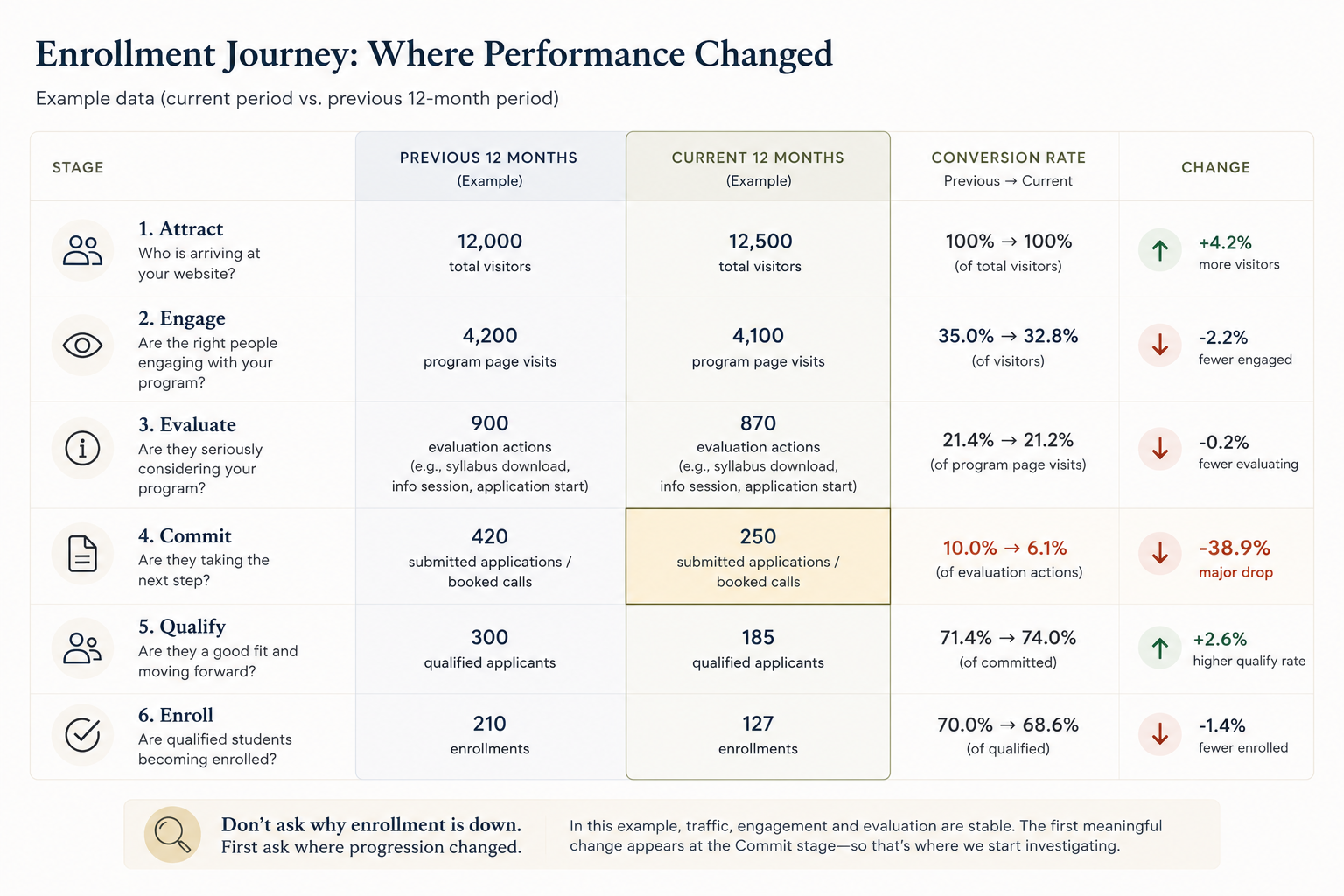
| Stage | Previous period | Current period |
|---|---|---|
| Attract | 12,000 visitors | 12,500 visitors |
| Engage | 4,200 program-page visits | 4,100 |
| Evaluate | 900 syllabus/info-session/application starts | 870 |
| Commit | 420 submitted applications | 250 |
| Qualify | 300 qualified applicants | 185 |
| Enroll | 210 enrollments | 127 |
Now we're getting somewhere.
Traffic didn't collapse.
Engagement didn't collapse.
Evaluation barely moved.
Something much more interesting happened around Commit.
That doesn't mean:
The application is definitely broken.
It means:
That's where I'd start investigating.
Maybe the application changed.
Maybe pricing was revealed immediately before it.
Maybe the program dates changed.
Maybe the application now takes twice as long.
Maybe a messaging change is attracting a slightly different audience.
Maybe an internal process is affecting progression.
Maybe something completely different is going on.
But now we're investigating a pattern, not reacting to a story.
One of the quickest wrong diagnoses: "We need more traffic"
I've seen this repeatedly.
Enrollment isn't where the business wants it to be, so the answer becomes:
More SEO.
More paid traffic.
More leads.
But when you look closer, traffic is healthy.
The business has done the difficult part.
People know them.
They're being found.
They have organic visibility.
They have direct traffic.
They may have a founder with considerable industry credibility.
And then the enrollment journey asks prospective students to fight their way through unnecessary complexity.
More traffic doesn't fix that.
It simply sends more people into the same experience.
And there's another nuance here.
Not everyone visiting the website was going to enroll anyway.
Most people aren't walking around the internet credit card in hand waiting for the correct certification website to appear.
They're researching.
Comparing.
Thinking.
Trying to understand what they want.
So I wouldn't describe every non-enrolling visitor as a "lost enrollment."
That overstates what the data tells us.
But I would ask whether the website helped that person move appropriately for where they were in the decision.
Did it help them understand the opportunity?
Did it help them evaluate?
Did it give them a reason to come back?
Did it bring them into your ecosystem?
Because someone who isn't ready now may become ready later.
And when they do, you don't necessarily want to start the relationship from zero again.
If you'd like to see how traffic, journey and messaging work together to move enrollment, my article on what actually drives online course conversion rate breaks it down further.
Another dangerous assumption: "Our price is too high"
Price is an easy explanation because it's visible.
People aren't enrolling.
Therefore:
They can't afford it.
And the obvious fix becomes discounting.
I've seen an established founder-led education brand repeatedly run discounts approaching 40% on a medium-ticket program suite.
Even with those discounts, its sitewide enrollment conversion was struggling to reach roughly 1%.
Direct purchase.
No admissions process.
Healthy organic and direct traffic.
A brand with real industry clout.
My reaction wasn't:
The discount isn't big enough.
It was:
Why isn't the enrollment performance reflecting the strength of the brand?
That leads me somewhere very different.
I'd want to look at the complexity of the journey.
Program discovery.
Navigation.
Decision points.
Messaging.
Pricing presentation.
Calls to action.
How the different offers relate to each other.
Whether people can work out what they actually need.
The price might still be part of the problem.
But discounting doesn't prove that price was the problem.
And if you reduce price before understanding the real constraint, you may simply sacrifice margin while leaving the underlying friction untouched.
Don't mistake timing for causation
This is another trap.
Imagine enrollment drops.
And six weeks earlier, you hired a new Head of Admissions.
It's very tempting to say:
There it is.
New admissions leader.
Enrollment fell.
Must be connected.
But what do we actually know?
Two things happened.
That's it.
Maybe the admissions process changed.
Maybe qualification became stricter.
Maybe traffic quality changed.
Maybe the payment plan changed at the same time.
Maybe the previous cohort had unusually strong demand.
Maybe there was seasonality.
Maybe applications were already declining before the admissions hire.
Until you look at the data across the journey, you don't understand what happened.
You have a story.
And believe me, I love a good story.
Our lives are made of them.
We probably tell ourselves 500 between breakfast and bedtime.
But unless we're talking about copywriting, a story isn't evidence.
If we're trying to fix an enrollment problem, I want to know what's:
real
measurable
comparable
and eventually:
actionable.
Build hypotheses. Don't manufacture problems.
This has become one of the most important principles in how I think about conversion optimization.
There's a huge difference between:
The program page isn't converting because the value proposition is weak.
and:
Program-page progression has declined. One hypothesis is that prospective students aren't understanding the value clearly enough. What evidence would support or weaken that explanation?
The first sounds confident.
The second is useful.
Because now I can investigate.
Maybe I look at:
- session recordings
- user testing
- program-page engagement
- CTA performance
- student questions
- admissions-call notes
- survey responses
- competitor positioning
- historical page versions
Maybe the value proposition is the problem.
Maybe it isn't.
The job isn't to arrive with the smartest-sounding opinion.
It's to get closer to what's actually true.
So what should you fix first?
I'd use this order.
If relevant traffic has fallen
Look at Attract.
What changed in traffic volume, source or audience?
If traffic is healthy but meaningful engagement has dropped
Look at Engage.
Are the right people arriving?
Are they recognising what they should do to enter your ecosystem, even if they're not ready to enroll?
Is your website experience giving them the next logical step, wherever they are in their journey?
If people engage but very few seriously consider
Look at Evaluate.
This could be your Download syllabus, information session, brochure request or even Start application step.
And remember that starting an application doesn't automatically mean someone was ready to apply.
They may simply be trying to understand the process or find information that wasn't available elsewhere.
So look at what your evaluation behaviours actually tell you about their level of intent.
If evaluation looks healthy but genuine commitment has fallen
Look at Commit.
What happens between:
"I'm interested."
and
"I'm taking the next step."
What's the application process like?
How well do they understand what's next?
Do unanswered questions appear during the process?
Are there moments where someone is expected to keep progressing without enough information or support?
If commitment is healthy but qualification progression has changed
Look at Qualify.
Admissions.
Applications.
Response times.
Criteria.
Handoffs.
How well is the student carried through a qualifying process that they often have little control over?
What's the admissions-call experience like?
How are follow-ups and updates handled?
And remember: some drop-off here is absolutely appropriate.
The question is whether you're filtering correctly or unnecessarily losing good-fit students.
If suitable students reach the final stages but aren't enrolling
Look at Enroll.
Don't jump straight to the payment page.
Look at the admissions experience.
The post-call experience.
Decision speed.
Acceptance.
Communication while they're waiting.
How clearly they're carried from acceptance to the next step.
Then look at payment, financing, deposits, checkout and final confirmation.
Where does confidence or momentum change?
And even then:
these are places to investigate, not conclusions.
That's the point.
What I'd want to see before telling you what to change
Before I told an established certification provider that they need more traffic, a new sales page, different pricing or better admissions, I'd ideally want to see:
- current and historical website traffic
- traffic sources
- program-page engagement
- meaningful evaluation behaviours
- applications or other commitment actions
- qualification-stage data
- admissions-call data where relevant
- acceptance and post-call progression
- enrollment numbers
- program value
- payment-plan changes
- cost per enrollment where available
- major operational or marketing changes during the period
Because without that, we're mostly swapping opinions.
And opinions are cheap.
The useful question is:
Where did performance change, and what does the evidence allow us to investigate next?
That's where the real work starts.
Your enrollments are down, but you're not sure why?
Don't start changing things at random. Let me have a look at your enrollment journey and data over a free discovery call, and we'll see whether there's enough evidence to warrant a deeper Enrollment Diagnostic.
About the author

Hanna-Mari Kirs
Founder & Strategist, Heroes & Guides
Hanna-Mari is an enrollment strategist researching how online educators, certification providers and course creators can improve student enrollment conversion through clearer enrollment journeys, decision-making psychology and website strategy.