Customer journeys
Your course is fine. Your enrollment journey needs attention.
Future students aren't just buying your course. Learn why certification enrollment starts long before someone clicks "Enroll Now"—and how to improve it.
There's an interesting shift happening in business.
For hundreds of years, companies competed on products. The "My shoe shine is better than yours and here's why" era defined the market.
Then came the services economy: "I'll not only sell you the shoe shine, I'll shine your shoes for you."
An experience economy refers to a market where the experience of buying and using something is as valuable as the product itself. Think of it as: "I'll shine your shoes while you enjoy a whisky and today's newspaper."
Now, according to the work of B. Joseph Pine II and James Gilmore, we're moving into what's known as the Transformation Economy. The Transformation Economy is a market where people pay not just for products, services, or experiences, but for the possibility of becoming someone different.
If you think about it, certification programmes have been in the transformation business from the very beginning.
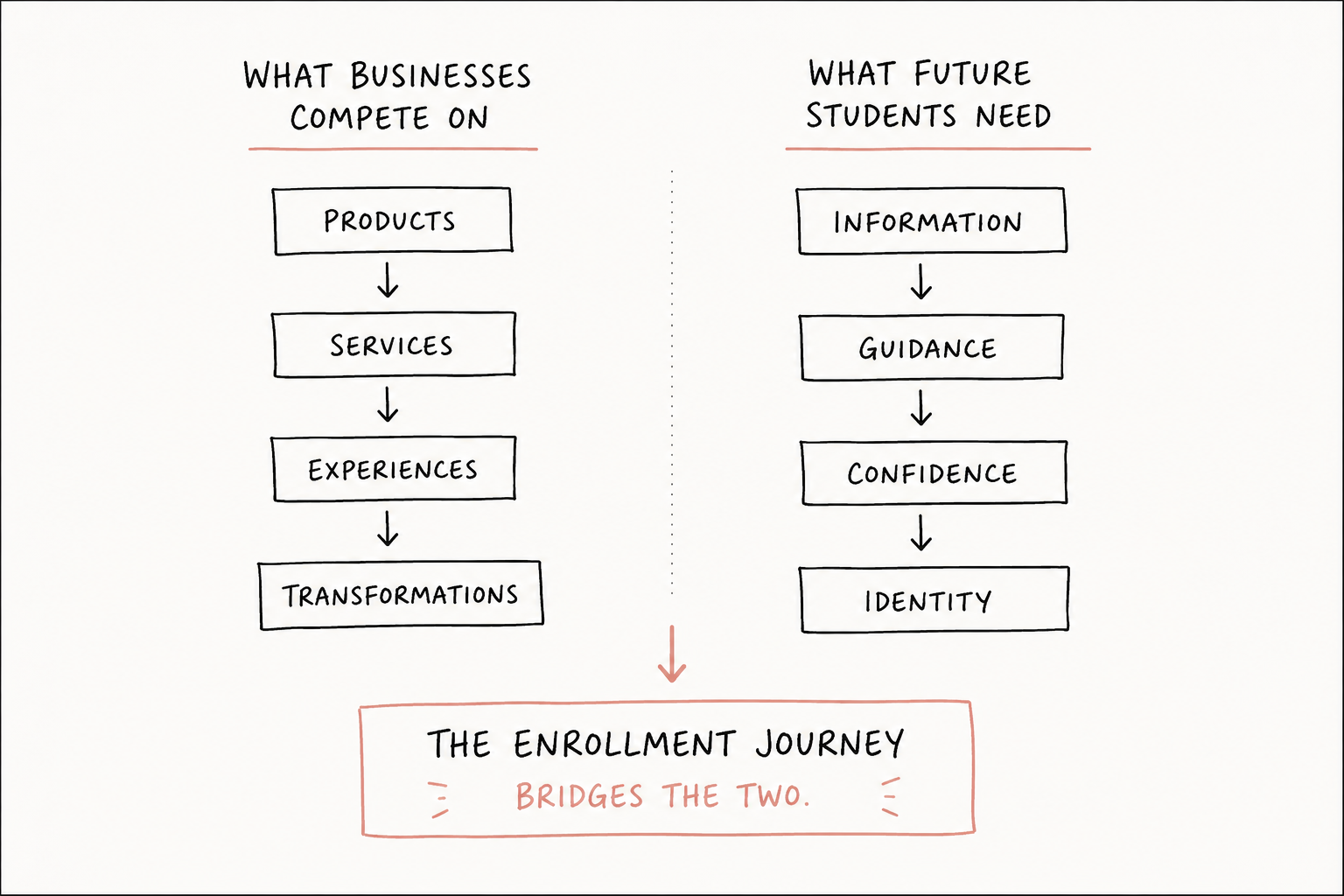
Nobody spends thousands on a certification because they're excited about twelve modules and a PDF workbook. Certification is an investment in the possibility of becoming a coach, therapist, consultant, leader, or practitioner.
I've been a complete story junkie for as long as I can remember, so this idea has always made intuitive sense to me.
One of my absolute favourite quotes is this one by Seth Godin: "People don't believe what you tell them. They rarely believe what you show them. They often believe what their friends tell them. They always believe what they tell themselves."
That last sentence has stayed with me for years. If it's true (and I dare say it is), then enrolment isn't really about convincing someone to buy your course. Enrolment is about helping someone tell themselves a new story, where they can genuinely picture becoming the person your programme promises they could become.
So I decided to put that idea to the test.
I reviewed twenty certification websites, specifically their student enrolment journeys, not to critique their design, but to understand how effectively they help future students step into that story. Many websites lack clear narratives, failing to make it obvious who the student will become after completing the certification.
I certainly found some of that.
But it wasn't the pattern that kept repeating itself.
One question followed me from one website to the next.
Where do I start?
Not because the information wasn't there.
Because I couldn't immediately see the path.
This was true across course websites, certification programmes, and professional development platforms alike. The content existed. The credentials were listed. The outcomes were described. But the moment I landed on the page, I was left to orient myself alone, and that moment of friction, however brief, was enough to make me hesitate.
Don't make me think.
At first, I assumed I'd spend most of my time noticing the usual things.
Weak headlines.
Confusing navigation.
Missing pricing.
Calls to action that were difficult to find.
Some of that was certainly there. In a few cases, I'd even guess it was the reason the average visit lasted barely twenty seconds. Several websites had bounce rates north of 50%, which means the majority of their hard-earned—and often paid-for—traffic arrived, looked around, became confused or disengaged, and left without exploring further.
If you want to compare your own numbers, I've pulled together the latest online course enrollment, website and conversion benchmarks in my 2026 Online Certification & Training Statistics report.
But that wasn't what stayed with me.
Instead, I found myself paying attention to something much more human.
How much mental work am I being asked to do? Mental work refers to the cognitive effort required to process information and make decisions.
Do I have to work out which programme is right for me?
Do I have to figure out where to begin?
Do I have to compare six different learning pathways before I even understand what this organisation actually offers?
Do I have to piece together information from three different pages just to answer one basic question?
Every extra question in the student enrolment journey I had to answer for myself made the decision feel a little heavier. When you're asking someone to invest $4,000 in a certification programme, "a little heavier" is often enough to stop the journey altogether.
It reminded me of Steve Krug's legendary book Don't Make Me Think—practically required reading for anyone working in digital product design.
His argument was beautifully simple.
The best websites don't force visitors to stop and think about how to use them. They feel obvious and almost effortless.
The more certification websites I reviewed, the more convinced I became that the same principle applies to enrolment.
Don't make me think where to start.
Don't make me think whether this programme is for someone like me.
Don't make me think whether I'm qualified enough.
Don't make me think whether I can realistically fit the coursework around my job and family.
Don't make me think whether I'll ever make back the investment.
Every unanswered question in the enrolment experience adds a little more uncertainty. Uncertainty refers to the state of being unsure about something, which can hinder decision-making.
At first glance, this looks like an information problem, but I don't think it is.
Most of the certification websites I reviewed weren't actually missing information. Many had detailed syllabi, instructor biographies, course comparisons, testimonials, and comprehensive FAQs. The information was almost always there.
It just wasn't helping me move forward.
On many course enrolment websites, the problem wasn't a lack of information. It was an abundance of equally plausible starting points. Certifications, specialisations, workshops, and advanced pathways all competed for attention before I'd even worked out whether I was in the right place.
That's not an information problem.
It's a guidance problem.
And, ultimately, I think it's a confidence problem.
Not sure whether your own enrollment numbers point to a problem? Calculate your enrollment health to see how your traffic, program value and enrollment pathway compare with available benchmarks.
Confidence isn't something you build. It's something you remove obstacles to.
At first, I thought I was looking for better storytelling.
Then I realised I was actually looking for something much simpler: confidence.
Not the loud, motivational kind. The quiet confidence that tells you you're making the right decision.
When someone is about to spend $4,000 on an online certification programme, they aren't just making a financial decision. They're making an identity decision. Somewhere in their mind, they're asking themselves questions they may never say out loud.
Can I really do this?
Am I experienced enough?
Will this actually change anything?
Will I regret spending this money six months from now?
Will my partner think this is a sensible investment?
Can I realistically fit this around work and family?
Can I picture myself as the kind of person who actually finishes this programme?
Those questions exist whether your website addresses them or not. The enrolment journey isn't creating that internal conversation. It's joining one that's already happening. If your future student doesn't even know where to begin, chances are their internal critic is already winning.
This was probably the biggest takeaway from the research. Most certification providers assume they're in the business of giving people information, but that's not quite true. They are helping someone make one of the biggest professional decisions of their life, and information alone rarely gets somebody over the line.
What actually moves people forward is confidence.
Not confidence built through hype or persuasion, but confidence built by quietly removing uncertainty, one question at a time. The role of an enrolment journey isn't simply to answer questions. It's to answer the right questions, at the right moment, in the right order.
That's an important distinction.
If I'm still trying to work out whether this certification is even for me, I don't yet care about the finer details of Module 8. I care whether I'm in the right place. Whether people like me have succeeded before. Whether there's a realistic path from where I am today to where I want to be tomorrow. Only once those questions are answered do I start caring about everything else.
One pattern kept repeating itself throughout the research. Most online academy websites weren't actually missing information. They had detailed syllabi, testimonials, accreditation details, FAQs, and instructor biographies. The problem was that the information often appeared in the wrong sequence.
I was introduced to advanced certifications before I understood the entry-level pathway. I was comparing specialisations before I'd even decided whether I believed in the methodology. I was reading about accreditation before I'd formed enough confidence that this organisation might actually be right for me.
That's why I don't think this is primarily an information problem.
It's a guidance problem.
If I could change one thing across almost every certification website I reviewed that would increase student enrolment across the board, it wouldn't be the colours, typography, or button placement.
I'd give future students a starting point.
And if you're already getting plenty of website traffic but not enough students are enrolling, I've written separately about where I'd look before spending more money attracting even more visitors.
Whether that's a "Start here" page, a short quiz, an introductory programme, or a simple roadmap doesn't matter nearly as much as the feeling it creates.
It quietly says:
"We've got you."
You don't have to work this out on your own.
We'll help you make sense of your options.
We'll show you where to begin.
The enrolment journey doesn't begin when someone clicks Enroll Now.
It begins much earlier.
It begins the moment someone starts imagining a different version of themselves and wonders whether it's actually possible.
Your enrolment journey can't create that dream. Your future students arrive with it already in their heads.
What it can do is help them believe that the journey from who they are today to who they hope to become is both clear and achievable.
And I think that's where so many certification providers miss an opportunity.
They spend so much time explaining the destination that they forget to show people the first step.
A simple exercise
If you want to improve student enrolment of your certification programmes, open your homepage.
Forget everything you know about your own organisation.
Imagine you're visiting your website for the very first time.
Then ask yourself one simple question:
Where do I start?
If the answer isn't obvious within the first few seconds, there's a good chance your future students are asking themselves exactly the same thing.
If you'd like me to have a look at your enrollment journey and data, we can do that over a free discovery call.
Key Takeaways
- We're no longer just selling products or experiences. Certification programmes have always been part of the transformation economy, where students buy the possibility of becoming someone new.
- Students don't enroll because they understand your course. They enroll because they can picture themselves becoming the person your course promises they could become.
- Enrolment isn't about convincing people. It's about helping them tell themselves a better story—one where taking the next step feels both exciting and achievable.
- Most enrolment problems aren't information problems. They're guidance problems. The information is often there, but it's not presented in the right order or at the right moment.
- The first question every enrolment journey should answer is: "Where do I start?" If that isn't immediately obvious, uncertainty begins to grow.
- Every unanswered question increases cognitive load. Future students shouldn't have to work out where to begin, which programme is right for them or whether they belong. Your enrolment journey should quietly remove those obstacles.
- Confidence isn't created through hype. It's created by systematically reducing uncertainty throughout the decision-making process.
- Your enrolment journey isn't creating your student's internal dialogue. It's joining one that's already happening. The role of your website is to support that conversation, not compete with it.
- People don't need more choices. They need a clear path forward.
- Transformation doesn't begin when the course starts. It begins the moment a future student lands on your website and starts believing that the future they're hoping for is genuinely within reach.
About the author

Hanna-Mari Kirs
Founder & Strategist, Heroes & Guides
Hanna-Mari is an enrollment strategist researching how online educators, certification providers and course creators can improve student enrollment conversion through clearer enrollment journeys, decision-making psychology and website strategy.